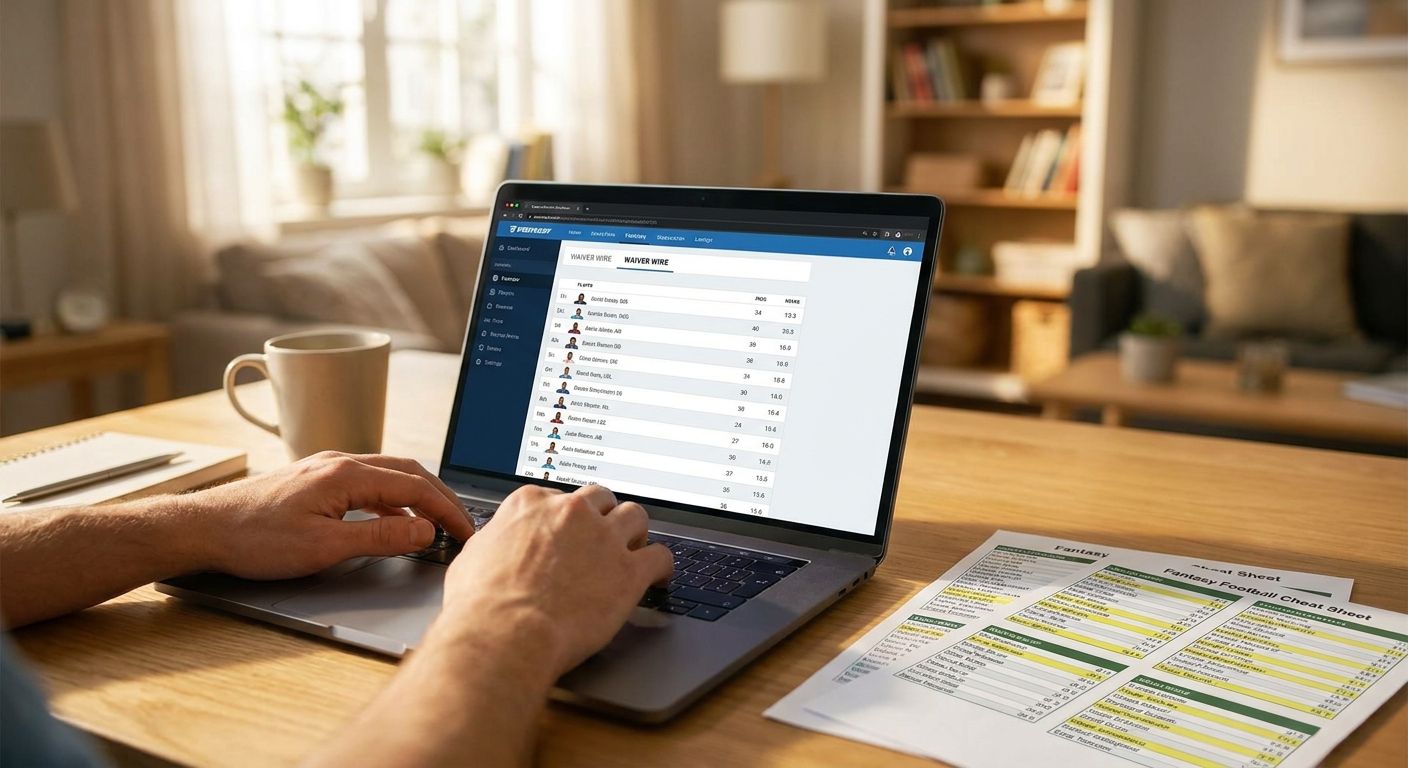
Waiver wire values for Sleeper leagues measure what a free agent is actually worth in your specific format — your PPR type, your bonus points, your IDP or superflex rules — not a generic FAAB tier list copied from a standard 10-team league. Sleeper's scoring engine lets commissioners stack TE premium, IDP tackle bonuses, and custom return yardage on top of the base rules, and a waiver value that ignores those settings is wrong before you even submit the bid. Managers running a vanilla half-PPR league can lean on generic rankings; managers running IDP, superflex, or custom bonus scoring in 2026 can't.
- Waiver wire values for Sleeper leagues have to match your exact scoring settings, not a generic FAAB chart.
- Sleeper's default 'Trending' add % measures volume across every league type, not your point spread — use it as a signal, not a bid guide.
- IDP tackle bonuses and superflex QB scarcity swing waiver value faster than standard RB/WR rankings account for.
- LeagueFrenzy pulls your league's actual scoring rules from Sleeper to build waiver values instead of guessing.
Why waiver wire values matter for Sleeper leagues
Sleeper is the platform most likely to host non-standard formats: IDP, superflex, TE premium, bonus yardage, even custom return-yard scoring buried three menus deep in league settings. A defensive tackle who's dead weight in a standard 12-team league can be a top-15 IDP asset in a league that scores solo tackles at 1.0 point and assists at 0.5. A backup quarterback nobody rosters in a one-QB league becomes a legitimate FAAB target the moment your league runs superflex.
Managers searching for waiver wire values for Sleeper leagues are almost always running one of these non-standard setups, and that's exactly where rankings built for a generic PPR league fall apart. Your league's scoring page is the actual source of truth — everything below builds from it.
Start with the LeagueFrenzy home page if you haven't connected a league yet; the process below assumes your scoring settings are on hand or your Sleeper account is linked.
Pull your league's real scoring settings first
Every waiver decision downstream depends on this step being right. Skip it and every tier list you build afterward inherits the error.
- Open League > Settings > Scoring in the Sleeper app and screenshot every category
- Note your PPR type (full, half, standard) and any per-catch bonus stacked outside the base line
- Flag IDP scoring if your league rosters DL, LB, or DB slots
- Check for TE premium, superflex, or bonus-yardage rules buried in the settings tab
- Confirm your FAAB budget total and the weekly reset day
Map position scarcity from your own bench, not ADP
ADP reflects a 12-team, one-QB, standard-scoring average. Your bench doesn't.
- Count open bench slots at each position before you place a bid
- Check how many teams in your league start 2+ RB, or how many run superflex
- Weigh tackle-heavy IDP defenders higher when solo tackles score 1+ point
- Discount kickers and streaming defenses unless bench limits are unusually thin
Build FAAB tiers using your league's actual point spread
This is where the manual approach and the faster approach split. Manually, you rebuild a projection spreadsheet against your scoring settings every single week — doable, but slow when six teams are bidding on the same tight end by Wednesday morning.
The faster path: the same league connection that powers LeagueFrenzy's Sleeper league trade analyzer also generates waiver-wire values already adjusted for your PPR type, IDP settings, and roster slots — no rebuilding a spreadsheet from scratch each Tuesday.
- Rank waiver targets by dollar-value tiers, not a single ordered list
- Rebuild tiers weekly — a Week 4 bench spot means nothing by Week 10
- Weight your remaining FAAB budget against how many weeks are left before the trade deadline
- Cross-check tiers against your bench's actual open slots, not a league-average roster
Track snap counts and target share every Tuesday
Waiver value moves faster than most managers check it. A player who was a handcuff on Sunday can be the lead back by Tuesday's waiver run.
- Pull snap percentage from box scores before Tuesday's waivers process
- Compare target share over the trailing three weeks, not just last week's box score
- Watch for offensive line or scheme changes that shift touches
- Flag committee backfields where no single back clears 60% of snaps
Flag bye-week fill-ins two weeks ahead
Bye weeks compound fast in 12+ team Sleeper leagues, and waiting until your starter's bye actually arrives means paying peak price for scraps.
- Check every starter's bye week against the full 2026 schedule
- Bid early on backups at bye-heavy positions before the rest of the league notices
- Stack streaming defenses and QBs around your own bye gaps in advance
- Hold back 10-15% of your FAAB budget for bye-week emergencies
Re-check IDP and superflex value shifts weekly
These two formats move waiver value the fastest and get updated the least by generic rankings.
- Re-rank IDP linebackers and safeties after snap-count changes, not just after one big tackle game
- Bump backup quarterbacks in superflex formats the moment a starter's snap share drops
- Watch for coordinator changes or a starter injury that shifts tackle volume to a new player
- Recheck TE premium values after target-share shifts — TE scarcity swings faster than RB or WR scarcity
Audit your bids against your league's actual FAAB pattern
League-average FAAB charts assume league-average behavior. Your twelve league mates don't bid that way.
- Track what winning bids actually looked like over the last 3-4 waiver cycles in your league
- Note whether your league overbids on QBs (common in superflex) or underbids on IDP assets
- Adjust your own tier cutoffs based on what your specific opponents pay, not a national average
Connect your Sleeper league
Pull waiver values built from your league's actual scoring rules.
Comparison: waiver wire value sources for Sleeper leagues
| Option | Best for | Key limitation |
|---|---|---|
| Sleeper's built-in "Trending" add % | A quick early-week pulse check | Counts adds across every scoring format, not yours |
| Generic FAAB percentage charts | New managers wanting a starting budget baseline | Built for standard PPR, ignores IDP, superflex, TE premium |
| Expert half-PPR rankings sites | Managers in vanilla half-PPR, one-QB formats | Doesn't adjust for bonus scoring or non-standard roster slots |
| LeagueFrenzy custom waiver values | Sleeper leagues running IDP, superflex, or custom scoring | Requires connecting your Sleeper league account |
Sleeper's Trending tab is a volume signal, not a value. It tells you who's being added league-wide across every scoring format on the platform — it says nothing about what that player is worth in your league's actual point spread.
Common mistakes Sleeper managers make on waivers
- Trusting Sleeper's default "Trending" percentage as a bid guide instead of a volume signal
- Valuing IDP defenders off tackle totals alone, ignoring assist or sack multipliers your league runs
- Forgetting the superflex bump on backup quarterbacks until a starter is already out
- Bidding the same flat FAAB percentage every week regardless of remaining bench scarcity
- Waiting until the bye week arrives to plan for it, then overpaying for the last name left on the wire
FAQ
What's the best way to value waivers in a Sleeper superflex league?
Rank backup quarterbacks and TE premium assets separately from a standard one-QB tier list, since superflex scoring inflates QB scarcity the moment a starter's snap share drops. Generic waiver charts built for one-QB leagues will underbid every quarterback on your wire.
Is Sleeper's Trending percentage a good FAAB guide?
No — it measures how many managers across every Sleeper league added a player, not what that player is worth in your specific scoring settings. Use it to spot who's moving, then value the player against your own IDP, PPR, and bonus rules.
How much FAAB should you bid on a top waiver target?
There's no universal number; it depends on your remaining budget, weeks left in the season, and how your specific league mates have bid in past cycles. Track your league's last 3-4 waiver cycles before setting a bid ceiling.
Does IDP scoring change waiver wire values?
Yes, significantly — a tackle-heavy linebacker who scores nothing in a standard league can be a top-15 IDP asset once solo tackles and assists carry point values. Waiver values for IDP leagues need to run through your league's exact tackle-and-assist scoring, not a generic defensive rankings list.
How often should you update your waiver board during the season?
Weekly, at minimum, and ideally by Tuesday before waivers process. Snap counts, target share, and injury news shift value fast enough that a board built on Sunday's box score is already stale by Wednesday's claims.
Can generic PPR rankings work for a Sleeper league with custom scoring?
Only if your league runs standard half-PPR or full-PPR scoring with no IDP, superflex, or bonus categories. Once your league adds any of those settings, generic rankings stop reflecting your actual point spread.
What's the difference between waiver wire values and trade values?
Waiver values measure a free agent's worth against your league's scoring for the immediate weeks ahead; trade values weigh season-long and, in keeper or dynasty formats, multi-year worth. Both need to run through the same league-specific scoring settings to be accurate.
How does LeagueFrenzy build waiver values for Sleeper leagues?
LeagueFrenzy connects directly to your Sleeper league and pulls your actual scoring settings, roster slots, and IDP rules to generate waiver values specific to your format rather than a generic chart.
One last thing
The fastest-moving waiver value in a Sleeper IDP league usually isn't the flashy running back everyone's chasing — it's the linebacker who just took over as the every-down tackler after a scheme change. That player's value can shift two full tiers in a single week, and a board built on last week's snap counts will miss it entirely. Recheck your IDP bench every Tuesday, not just at the trade deadline.