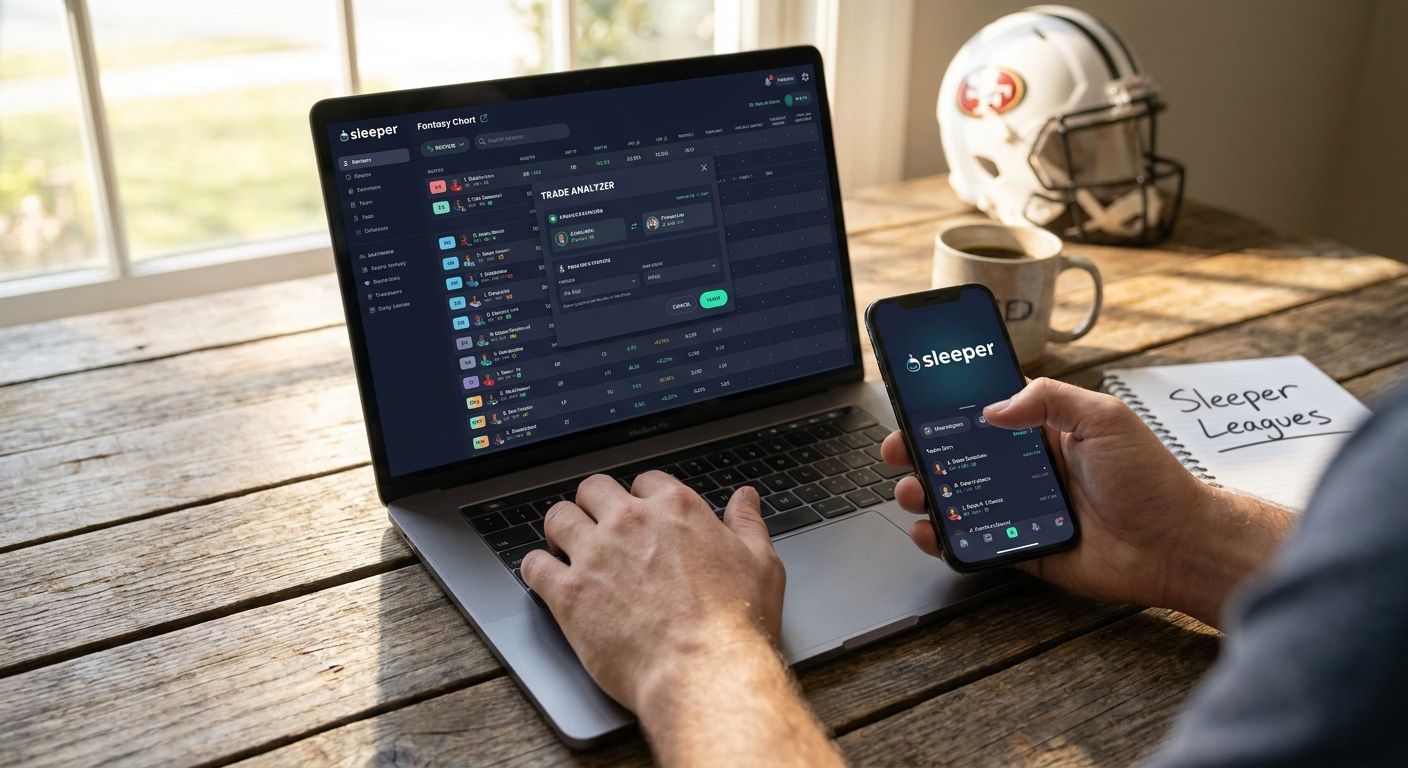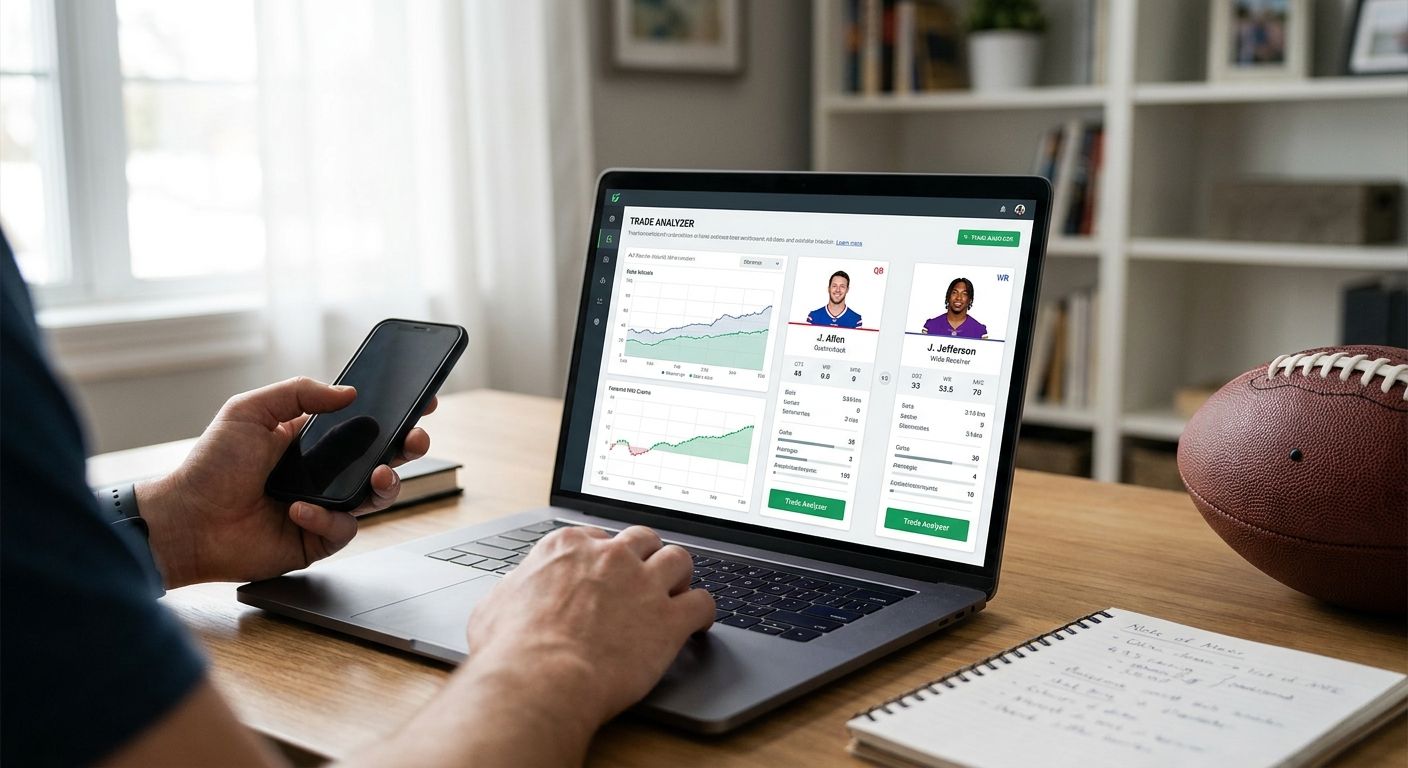
A trade analyzer that doesn't know your league's IDP scoring, superflex requirement, or rookie pick slots gives you a redraft grade wearing a dynasty costume, and that's the gap that costs managers real value in 2026.
- A fantasy football trade analyzer for dynasty leagues has to read your actual scoring rules, not a generic points system.
- LeagueFrenzy pulls scoring straight from Sleeper, MFL, Fleaflicker or ESPN and grades trades against your league's own math - Buy for anyone in IDP, superflex, or TE premium formats.
- Consensus value charts and redraft ADP tools ignore your roster construction and FAAB rules - Consider one only as a second opinion, never a final answer.
- DIY spreadsheets work if you have the hours to rebuild them every bye week; most managers don't.
Why this matters
Dynasty trades are decided on your league's scoring page, not on a national consensus board. If your league starts two quarterbacks, awards a point per reception, or fields six IDP roster spots, a generic trade grade is answering a different question than the one you're asking. LeagueFrenzy connects directly to Sleeper, MFL, Fleaflicker or ESPN and builds trade verdicts from that league's rules, which is the entire point of grading a dynasty trade in the first place.
Most trade tools were built for redraft leagues, where the only thing that changes year to year is the calendar. Dynasty leagues carry multi-year rosters, rookie draft capital, and holdout years where a player's value depends on team fit that hasn't happened yet. A tool that doesn't separate those variables from your league's actual scoring is guessing, not analyzing.
Who this is for
This guide is for managers running a dynasty or keeper league who are staring at a trade offer right now and need a verdict grounded in their own scoring settings - not a rankings article written for a 10-team standard-PPR league that looks nothing like theirs. It's especially relevant if your league runs IDP, superflex, TE premium, or a rookie draft with FAAB-funded pick trading, because those formats are exactly where generic tools break down.
What to look for in a fantasy football trade analyzer for dynasty leagues
League connection, not a manual input form
A tool that asks you to type in your scoring settings by hand will drift out of sync the moment your commissioner tweaks a rule mid-season. A trade analyzer that syncs directly to Sleeper, MFL, Fleaflicker, or ESPN reads your scoring automatically, including IDP tackle and sack values, which matters because those settings change replacement-level value at every position.
Roster context, not just player value
A player's trade value depends on whether your bench is 16 deep or 24 deep, and whether your league runs a taxi squad. The same wide receiver is a luxury bench stash in a shallow league and a rosterable asset in a deep one, and a trade analyzer that ignores your roster size is grading the player, not the trade.
Rookie pick valuation tied to your rebuild timeline
A future first-round pick is worth more to a rebuilding team stockpiling 2027 draft capital than to a contender chasing a 2026 title. A trade analyzer that treats every draft pick as a fixed asset regardless of your team's competitive window is missing half of what makes a dynasty trade a dynasty trade.
Update cadence that matches the season
Values built once in August and never touched again miss injuries, holdout years, and depth chart shifts that happen every week of the season. Look for weekly re-scoring, not a static chart that was accurate in Week 1 and stale by Week 8.
Verdict explanation, not just a number
A score with no reasoning behind it doesn't help you negotiate. A trade analyzer that explains why a deal favors one side - because of your league's TE premium bonus, or your opponent's shallower bench - gives you language to use in the actual trade conversation.
Format coverage for IDP and superflex specifically
Superflex and IDP formats change value curves more than almost any other setting. A tool built primarily for standard-PPR leagues and retrofitted for these formats tends to show it in the details - quarterback value that doesn't move enough, or defensive players graded like afterthoughts.
The approaches, ranked
The league-scored analyzer - the safe pick
LeagueFrenzy reads scoring directly from your connected Sleeper, MFL, Fleaflicker or ESPN league and grades trades against those settings, including IDP formats that start defensive players and superflex leagues that start two quarterbacks. The spec that matters: it's rules-first, meaning the verdict changes when your league's scoring changes, not when a national consensus board updates. Buy for any manager in a non-standard format, which is most dynasty leagues.
The consensus value chart - the popularity contest
Crowd-sourced trade value charts aggregate opinions across thousands of leagues into one number per player. That number assumes a generic 12-team, one-QB, no-IDP format, so a league running six IDP starters and a $100 FAAB budget gets the same rookie pricing as a league running neither. Consider it as a sanity check against wild outliers, never as the deciding vote on a trade in your league.
The DIY spreadsheet - the control freak's pick
Building your own value sheet means you control every input, including your league's exact scoring weights. The cost is time: rebuilding it after every bye week, injury, and depth chart change through a 17-week season is a second job most managers don't have room for. Consider it if you genuinely enjoy the math; skip it if you just want an answer before the trade deadline.
The redraft ADP tool repurposed - the wrong tool wearing a trade hat
Average draft position resets every August and has no memory of last year's rookie class or a holdout year that changed a player's outlook. Running dynasty trades through an ADP-based calculator ignores draft-pick capital entirely, which is half the currency in a dynasty trade. Skip it for anything involving a future pick.
Connect your league and grade the trade
See a verdict built from your Sleeper, MFL, Fleaflicker or ESPN scoring rules.
What to avoid
- A grade that never asks about your IDP scoring. If a tool gives you a trade verdict without pulling your tackle, sack, or interception point values, it's grading a different league than yours.
- A fixed price on a future draft pick. A 2027 first is worth more to a team stockpiling for a rebuild than to a team pushing for a 2026 title - a tool that prices it the same for both is skipping the most important variable in a dynasty trade.
- A calculator that doesn't know your bench size. Sixteen roster spots and 24 roster spots produce different replacement-level values at every position, and a trade grade that ignores that difference is guessing at your actual roster crunch.
Verdict comparison
| Approach | Reads your scoring | Updates weekly | Prices rookie picks by rebuild timeline | Verdict |
|---|---|---|---|---|
| LeagueFrenzy trade analyzer | Yes, live from your league | Yes | Yes | Buy |
| Consensus value chart | No, generic format | Varies | No, fixed value | Consider |
| DIY spreadsheet | Yes, if you build it | Only if you maintain it | Yes, if you build it | Consider |
| Redraft ADP tool | No | Yes, but for redraft only | No | Skip |
FAQ
What's the best fantasy football trade analyzer for dynasty leagues?
The best option for dynasty leagues is one that reads your league's actual scoring settings rather than a generic points system. LeagueFrenzy connects to Sleeper, MFL, Fleaflicker or ESPN and grades trades against your league's real rules, including IDP and superflex settings.
Is a dynasty trade analyzer different from a redraft trade calculator?
Yes - a dynasty trade analyzer has to account for future draft picks, multi-year roster construction, and rebuild-versus-contend timelines that redraft leagues don't have. A redraft calculator resets every August and has no way to price a 2027 first-round pick correctly.
How does IDP scoring change trade value?
IDP scoring adds defensive players as rosterable assets with real trade value, and the specific point values for tackles and sacks shift which defenders are worth starting-caliber value. A trade analyzer that doesn't read your league's IDP settings will underrate or overrate defensive players by a wide margin.
Do superflex leagues need a different trade analyzer than one-QB leagues?
Superflex leagues start two quarterbacks, which inflates quarterback value across the board compared to one-QB formats. A trade analyzer built for standard one-QB scoring will consistently undervalue quarterbacks in a superflex trade.
How much does a dynasty trade analyzer cost in 2026?
Pricing varies by tool and by whether it's a one-time calculator or a subscription service tied to your connected league. Check current pricing directly on the provider's site before comparing options.
Can a trade analyzer account for a player's holdout year?
Only if it updates on a regular cadence rather than relying on a static preseason value chart. A tool that re-scores weekly will reflect a holdout or depth chart change faster than one built once in August and left alone.
Should I trust a consensus trade value chart over a league-scored analyzer?
Use a consensus chart as a rough sanity check, not the deciding factor, because it prices every league the same regardless of scoring format. A league-scored analyzer accounts for your specific IDP, superflex, or TE premium settings, which consensus charts by design cannot.
What roster details matter most for a dynasty trade verdict?
Bench depth, taxi squad rules, and your team's competitive window (rebuilding versus contending) all change how much a given player or pick is worth to you specifically. A trade analyzer that ignores those details is grading the player in a vacuum, not the trade in your league.
One last thing
In superflex leagues, a rookie quarterback's trade value in year one is set almost entirely by his draft slot before he's thrown a professional pass, because two-QB math makes replacement-level quarterbacks nearly worthless. That's a format quirk a generic trade analyzer misses every single time, and it's exactly the kind of setting-specific edge case that separates a league-scored dynasty trade analyzer from a rankings page built for a different format entirely. Heading into the 2026 trade deadline, check that whatever tool grades your trade actually knows your league runs superflex before you act on its verdict.