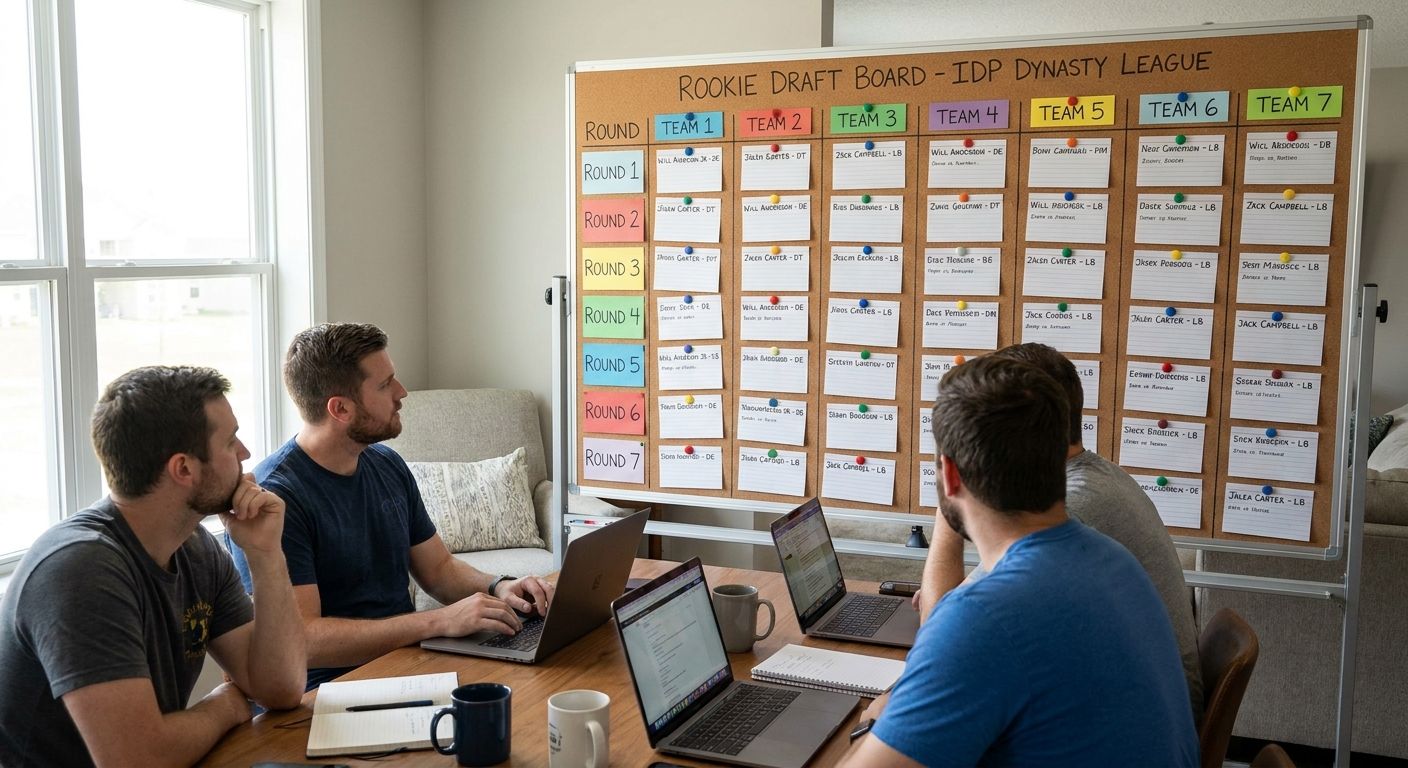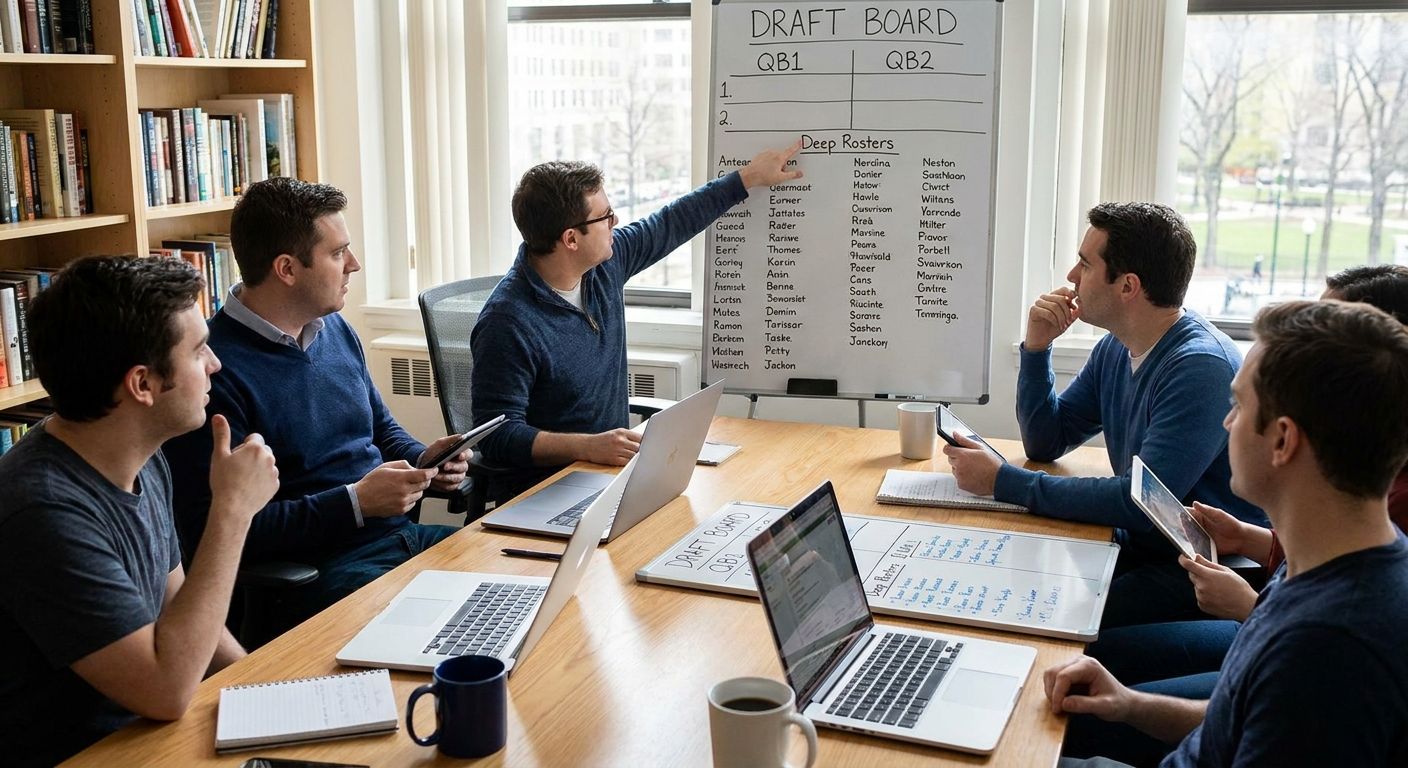
Deep-roster 2QB leagues punish generic ADP harder than any other format on LeagueFrenzy's radar. Best overall 2QB draft strategy for 2026: Early Double-QB Lock. Best for deep rosters: Hero QB + Bench Dam. Best budget option: Zero-QB Wait-and-Stream. The other two strategies below cover superflex/TE premium hybrids and dynasty startups.
- Best 2QB draft strategy overall in 2026: Early Double-QB Lock inside the first four rounds.
- Best for deep rosters: Hero QB + Bench Dam, stacking three to four backup QBs late.
- Zero-QB only works if your league's replacement QB scores within a few points of starters.
- Superflex and TE premium scoring need a league-specific board, not generic ADP.
- Dynasty 2QB startups should bank rookie QB capital; one-year redraft leagues should skip it.
Why this matters
Standard fantasy analysis treats QB as one position with one replacement level. True 2QB leagues break that assumption completely: you're forced to start two passers every week, and the gap between a QB1 and a waiver-wire QB3 is often double digits per game.
Generic best-ball rankings and mock-draft ADP get built for single-QB leagues, then get bolted onto 2QB formats with a rough multiplier. That's how a manager ends up reaching for a mediocre QB2 in round 5 when the real value was sitting on the waiver wire in September. A custom draft board built from your league's own scoring settings closes that gap before the draft even starts. Check the LeagueFrenzy homepage for how the connection to Sleeper, MFL, Fleaflicker or ESPN works.
What makes the best 2QB draft strategy for deep rosters
- Prices QB2 against your league's actual replacement level, not a national ADP average
- Accounts for bench depth, taxi slots, and IR eligibility instead of assuming a 16-round draft
- Survives a Week 6 injury to your QB1 without forcing a waiver-wire scramble
- Distinguishes true 2QB (must start two) from superflex (start one QB or a flex)
- Leaves enough draft capital left over that RB/WR/TE isn't an afterthought
- Adjusts for TE premium, IDP, or rushing bonuses that change how QB scarcity actually pays out
2QB draft strategies at a glance
| Strategy | Best For | Standout Feature | Key Limitation |
|---|---|---|---|
| Early Double-QB Lock | Overall floor certainty | Both starters locked by round 4-5 | Costs early RB/WR capital |
| Hero QB + Bench Dam | Deep rosters (20+ picks) | Stacks 3-4 backup QBs late | Clogs bench in shallow formats |
| Zero-QB Wait-and-Stream | Budget/late-round builders | Maximizes RB/WR/TE value early | Risky if replacement QB scores far below starters |
| Superflex Value-Based Draft | Superflex + TE premium hybrids | Follows true value, not position | Needs a league-specific board to price correctly |
| Rookie QB Dynasty Build | Dynasty and keeper 2QB startups | Banks long QB holdout windows | Dead weight in year one |
1. Early Double-QB Lock: best 2QB draft strategy for overall floor certainty
Lock a clear QB1 in rounds 1-3 and a legitimate QB2 by round 4 or 5, before the position thins out. In a true 2QB league running 6-point passing touchdowns, the drop-off from a top-12 QB to a replacement-level starter is steep enough that closing the QB slot early removes a full category of weekly risk.
Early Double-QB Lock pros:
- Removes weekly QB-streaming stress for the entire season
- Rewards leagues with 6-point passing TDs and no PPR discount on the position
- Gives you two proven weekly scorers before your league-mates finish their RB2
Early Double-QB Lock cons:
- Costs RB1/WR1 draft capital you can't recover later
- Overpays for the position in rushing-heavy IDP formats where QB scarcity matters less
- Leaves you thin if your bench can't absorb a QB1 bust
Best for: managers who already have a solid RB/WR base through keepers or trades and want the QB slot settled early.
Verdict: Run it.
2. Hero QB + Bench Dam: best 2QB draft strategy for deep rosters
Draft one unquestioned QB1 early, then use bench slots in rounds 8-14 to stack three or four backup quarterbacks. Deep-roster 2QB leagues (20-24 total spots) waste bench slots on RB4s and WR5s that never see the field; those same slots absorb QB depth instead.
Hero QB + Bench Dam pros:
- Exploits bench slots that would otherwise sit unused in a deep format
- Spreads bye-week and injury risk across a QB timeshare instead of one backup
- Frees early draft capital for RB/WR since QB2 gets solved late
Hero QB + Bench Dam cons:
- Clogs the bench in leagues running fewer than 20 roster spots
- Requires active waiver cycling to keep the QB4 slot relevant
- Underperforms if your league doesn't grant IR or taxi slots for the extra bodies
Best for: leagues with 20+ round drafts and real bench depth, where a fifth or sixth QB isn't wasted.
Verdict: Run it.
“If your bench can't absorb a QB1 bust in Week 6, you drafted the wrong strategy.”
3. Zero-QB Wait-and-Stream: best 2QB draft strategy for budget builders
Skip quarterbacks entirely through round 8, build out RB/WR/TE first, then stream matchup-friendly QBs off waivers starting in September. This works when your league caps passing touchdowns at 4 points and the gap between a starter and a streamer stays tight.
Zero-QB Wait-and-Stream pros:
- Maximizes skill-position value in the rounds that matter most
- Exploits deep waiver pools if your league's FAAB budget allows repeated claims
- Avoids overpaying for QB scarcity that doesn't actually exist in lower-scoring passing formats
Zero-QB Wait-and-Stream cons:
- Dangerous in a true 2QB league where you must field two starters weekly, not one flexible slot
- A late-round miss leaves you starting a bad matchup with no bench cushion
- Drains FAAB budgets fast if three or four managers are streaming the same replacement pool
Best for: managers who'd rather bank draft capital on RB/WR and only in leagues where the QB replacement gap is genuinely small.
Verdict: Wait — check your league's actual point gap between QB12 and QB20 before committing to this one.
4. Superflex Value-Based Draft: best 2QB draft strategy for TE premium hybrids
Draft the highest-value player on the board regardless of position, letting value-based drafting math naturally push four to six QBs into your first five rounds. This suits leagues that blend superflex with TE premium or return-yardage scoring, where standard positional rankings misprice everything.
Superflex Value-Based Draft pros:
- Matches how superflex scoring actually pays out: QBs are scarce and high-ceiling
- Avoids reaching for a position just because a roster slot says so
- Adapts naturally to TE premium bonuses that generic superflex ADP ignores
Superflex Value-Based Draft cons:
- Falls apart without a real league-specific board — generic superflex ADP sheets still underrate QB in leagues running full 6-point passing plus a TE premium bonus
- Hard to execute live without pre-built tiers, since value shifts pick to pick
- Overcorrects toward QB in leagues that only lightly reward the position
Best for: superflex leagues stacking TE premium or return yardage, where standard rankings consistently misprice the QB slot. A superflex-specific ranking set built for dynasty startups shows how far these prices drift from generic boards.
Verdict: Run it, but only with a league-specific board.
5. Rookie QB Dynasty Build: best 2QB draft strategy for dynasty and keeper leagues
Prioritize rookie QB draft capital and multi-season holdout windows over immediate 2026 production. Dynasty 2QB startups reward long QB runways in a way single-QB dynasty leagues don't, since rookie passers carry more trade value when two starting slots exist to fill.
Rookie QB Dynasty Build pros:
- Dynasty 2QB startups reward multi-year QB windows more than any other format
- Rookie QB draft capital trades at a premium in true 2QB leagues
- Builds a long-term floor that doesn't depend on one 2026 breakout
Rookie QB Dynasty Build cons:
- Produces close to nothing in year one
- Tough sell in keeper leagues with short retention windows
- Backfires if your league voids keeper rights after one or two seasons
Best for: dynasty startups and keeper leagues with long QB retention rules, not one-year redraft formats.
Verdict: Hold in dynasty; skip in shallow keeper or one-year redraft leagues.
How this list was ranked
Each strategy got measured against the same six criteria above: replacement-level pricing, bench depth, injury survivability, format fit (true 2QB vs superflex), draft-capital balance, and scoring-rule sensitivity for TE premium or IDP. Early Double-QB Lock wins overall because it satisfies the most criteria across the widest range of league sizes; the other four win narrower, specific fits instead of competing on the same axis.
Build your league's 2QB draft board
Generate a draft board tied to your league's actual scoring rules, not generic ADP.
Which 2QB draft strategy should you run in 2026?
If you're undecided heading into your 2026 draft, default to Early Double-QB Lock unless your roster is genuinely deep (20+ spots). In that case, Hero QB + Bench Dam captures more value from bench slots you'd otherwise waste. Only run Zero-QB if you've actually checked your league's QB12-to-QB20 point gap and it's small; don't run it on a hunch.
FAQ
What's the best 2QB draft strategy for 2026 drafts?
Early Double-QB Lock is the best overall 2QB draft strategy for 2026, locking both starters by round 4 or 5. Deep-roster leagues do better with Hero QB + Bench Dam, which stacks backup QBs into late-round bench slots.
Is 2QB different from superflex?
Yes. True 2QB leagues force you to start two quarterbacks every week, while superflex leagues let one flex slot hold a QB, RB, WR, or TE. The strategies differ because superflex gives you an escape hatch a true 2QB league doesn't.
How many QBs should I draft in a 2QB league?
Most managers need at least three or four QBs on a standard 2QB roster to cover byes and injuries. Deep-roster leagues with 20 or more spots can support five or six under the Hero QB + Bench Dam approach.
What's the best 2QB draft strategy for deep rosters specifically?
Hero QB + Bench Dam is the best 2QB draft strategy for deep rosters, since it uses otherwise-wasted late bench slots to stack three to four backup quarterbacks behind one early QB1.
Should I punt RB/WR to load up on QBs in 2QB leagues?
No. Even Early Double-QB Lock only commits three to five picks to the position; the rest of your draft still needs to build RB/WR/TE depth to be competitive.
How does TE premium change 2QB draft strategy?
TE premium scoring shifts value-based draft math toward Superflex Value-Based Draft, since generic superflex ADP underprices QB when a TE premium bonus stacks on top of 6-point passing touchdowns.
Is a zero-QB approach ever right in a true 2QB league?
Only if your league's replacement-level QB scores within a few points of a starter. If the gap runs into double digits per game, as it does in most 6-point passing leagues, Zero-QB is too risky.
Do dynasty 2QB leagues need a different draft strategy than redraft?
Yes. Dynasty 2QB startups benefit from banking rookie QB draft capital under the Rookie QB Dynasty Build approach, since multi-season holdout windows pay off differently than a one-year redraft league.
One last thing
Generic ADP sheets don't know whether your league runs 4-point or 6-point passing touchdowns, and that single setting moves QB value more than almost any other input in a 2QB format. Before locking in a strategy for 2026, check that number in your league's scoring settings — it decides whether Early Double-QB Lock or Zero-QB Wait-and-Stream actually fits.