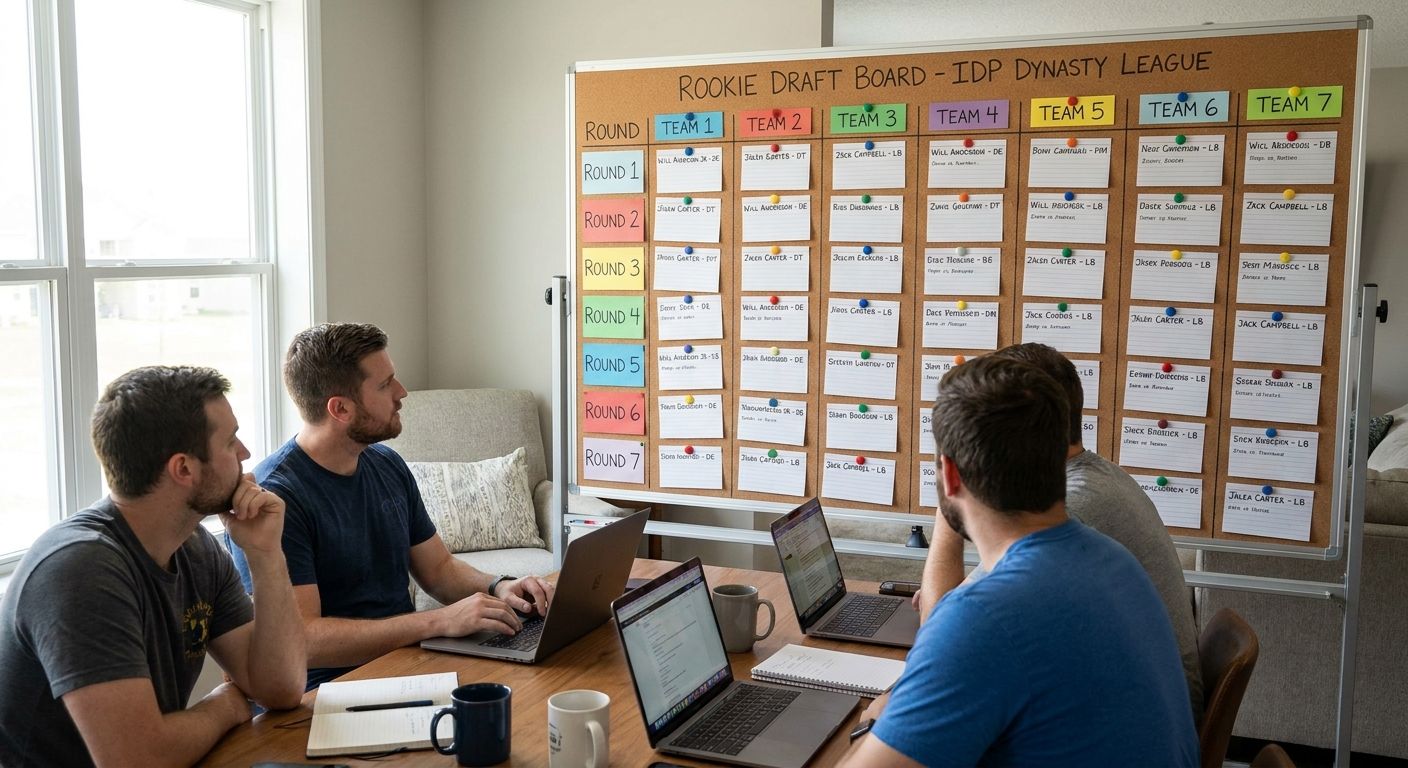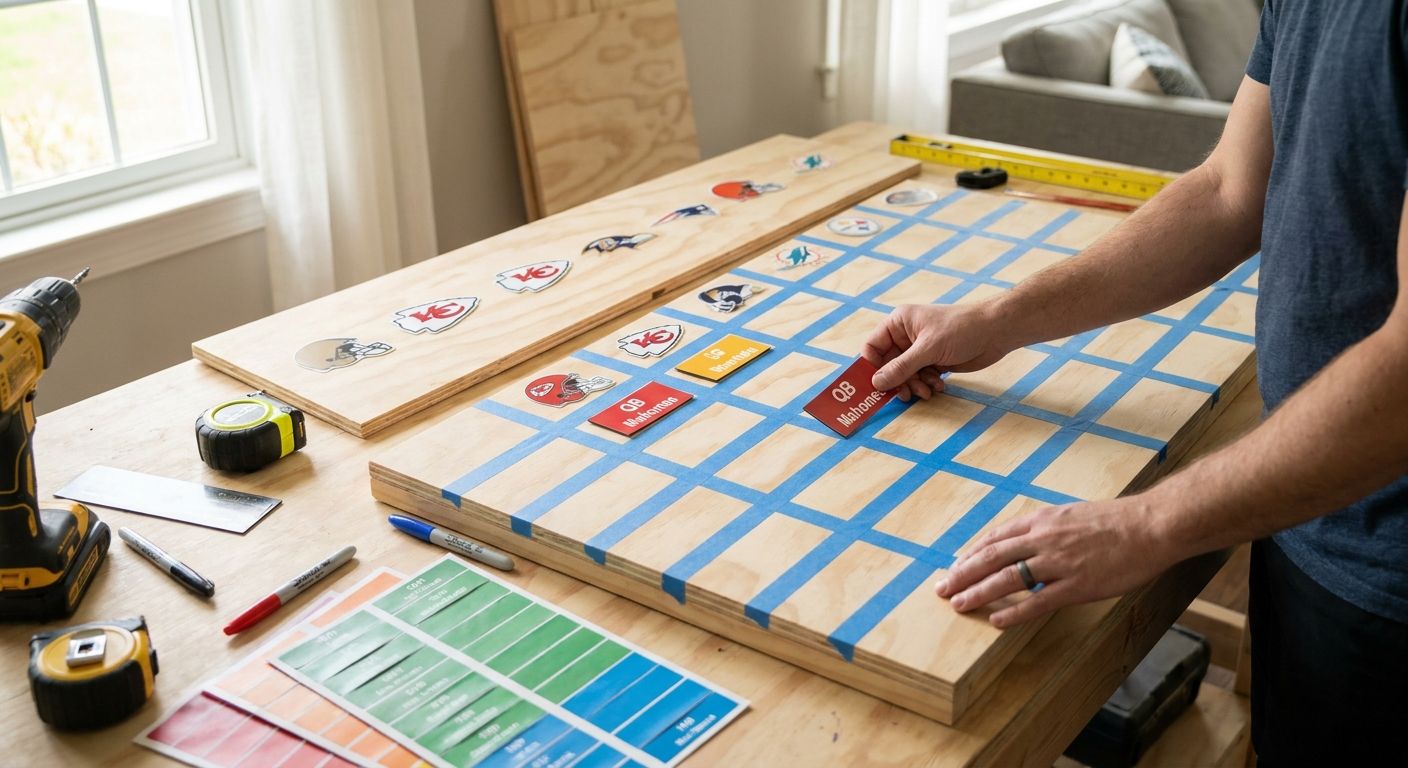
A fantasy football draft board only works when it's built from your league's actual scoring and roster rules, not a public top-200 list — pull the scoring settings, map the starting lineup requirements, then rank every rostered-relevant player by projected points under those exact rules for the 2026 season.
- Building a fantasy football draft board starts with your league's scoring settings, not a public rankings list — pull them straight from Sleeper, MFL, Fleaflicker or ESPN.
- Auction leagues need dollar tiers layered on top of rank order; snake drafts need positional runs flagged by ADP gaps.
- Superflex and IDP leagues move quarterbacks, linebackers and defensive backs to entirely different tiers than a standard PPR board.
- Rebuild the board every season heading into 2026 — a scoring tweak or a new keeper rule breaks last year's tiers.
Why this matters
Public rankings assume one default: full PPR, 12 teams, no IDP, no superflex, standard bench size. Your league almost certainly breaks at least one of those assumptions, and every place it does moves players tiers away from where a generic list puts them.
Leaguefrenzy connects to your Sleeper, MFL, Fleaflicker or ESPN league and builds a fantasy football draft board from the scoring and roster settings already on file — no manual scoring lookup, no guessing at your commissioner's IDP tackle-and-sack values.
A run-heavy IDP league can push a top-15 standard-scoring linebacker into the second round. A superflex league does the same to a backup-caliber quarterback who barely cracks single-quarterback boards. In a 12-team full-PPR league versus a 10-team half-PPR league, the same running back can sit two full tiers apart.
“The scoring settings decide the board, not the players' name recognition.”
How to build a fantasy football draft board
Six inputs turn a blank spreadsheet into a usable draft board. Skip any one of them and the board drifts back toward a generic rankings list.
- Pull your league's scoring settings. PPR value (0, 0.5 or 1 point per reception), TE premium bonuses, IDP point values for tackles, sacks and turnovers, and any bonus thresholds for yardage or touchdowns.
- Map your roster requirements. Starting lineup slots, flex and superflex slots, IDP starting slots (DL/LB/DB), and bench size — a 16-round draft board looks nothing like a 20-round one.
- Lock in your format. Redraft, keeper or dynasty changes which players even belong on the board; keeper leagues drop already-kept players, dynasty adds rookie picks as separate assets.
- Rank every rostered-relevant player by projected points under your settings — not raw ADP, which is averaged across leagues that don't share your rules.
- Group ranks into tiers, flagging the gaps where a run at a position is likely to start.
- Convert rank into value — dollar amounts for auction leagues, pick equity for dynasty rookie boards.
How those six inputs change the board depends on format. The table below shows what shifts and what extra step each format adds on top of the base ranking.
| Draft format | What changes the board | Extra step needed |
|---|---|---|
| Snake redraft | Standard tiering by projected points | None beyond scoring settings |
| Auction | Same ranks, plus a dollar value per tier | Convert rank to budget-scaled price |
| Keeper | Removes kept players, adjusts cost basis | Apply keeper penalty before ranking |
| Dynasty/rookie | Blends veteran value with pick value | Rank rookies on capital, not stats |
| Superflex | Quarterback tier moves up the whole board | Re-rank QBs against every position |
| IDP | Adds defensive players ranked by tackles/sacks | Pull IDP scoring settings separately |
Auction draft boards
Auction draft boards need one more layer than snake boards: a dollar figure attached to every tier, scaled against your league's total budget. A $200-budget auction league and a $500-budget auction league produce completely different nomination strategies even with identical player ranks underneath.
Tiers still do the heavy lifting — the dollar value just tells you how far to push before a tier breaks. Leaguefrenzy's auction draft board converts your league's scoring-based ranks into per-player values scaled to your budget, so nomination order and price ceilings come from your league's math instead of a flat national average.
Keeper league draft boards
Keeper league draft boards start by removing every player your league already kept, then adjusting cost — usually a round penalty or a draft-pick cost tied to when the player was originally drafted. The board only works if that keeper cost is baked in before ranking begins, not bolted on after.
A keeper-adjusted board also shifts value that raw production rank misses: a player kept cheap in round 10 is worth more than his stats alone suggest, because he's occupying a bargain roster spot instead of a full-price pick.
Dynasty and rookie draft boards
Dynasty draft boards blend two separate rankings into one board: veteran value under your current scoring, and rookie pick value under the incoming 2026 class. Rookie picks carry no season of NFL data yet, so their rank leans on draft capital, landing spot and college production instead of projected fantasy points.
Leaguefrenzy's dynasty rookie draft board separates those two inputs so a rebuilding team can weigh a first-round rookie pick against a 28-year-old veteran without mixing two different types of uncertainty into one number.
Superflex and IDP draft boards
Superflex leagues start two quarterbacks, which moves the entire quarterback tier up the board — a QB2 that's droppable in a single-quarterback league becomes a top-40 asset in superflex. IDP leagues add defensive players to the board entirely, ranked by tackle, sack and turnover scoring instead of touchdowns and yardage.
Neither format works on a standard-PPR board with a few players manually bumped up. The scoring change touches every tier, not just the position it looks like it touches first.
Why draft boards vary league to league
A handful of settings account for most of the difference between your board and a generic top-200 list:
- PPR value — half-PPR and standard scoring shift running backs and possession receivers in opposite directions from full PPR.
- TE premium — a per-reception bonus for tight ends moves the position up a full tier or more.
- IDP scoring rules — tackle-heavy scoring favors linebackers; big-play scoring favors defensive backs and edge rushers.
- Superflex or two-QB starting slots — the entire quarterback position reprices against every other position.
- Roster and bench size — deeper benches extend the usable board further into waiver-tier players a shallow league would never draft.
- Keeper or dynasty rules — cost basis and rookie pick value change who's worth rostering at all.
Related questions
Do I need a different draft board for PPR vs. standard scoring?
Yes — half-PPR and standard scoring drop pass-catching running backs and possession receivers several tiers compared to a full-PPR board, because the reception itself stops being worth a full point. Running backs who catch 60-plus passes a season lose the most value moving from full PPR down to standard.
How early should I build my draft board before draft day?
Build the first draft of the board as soon as your league's scoring and roster settings are locked for the season, then update it after the last week of preseason cuts and depth-chart moves. A board frozen in July misses training-camp injuries and backfield battles that don't resolve until late August 2026.
Can I use a generic top-200 rankings list instead of a custom board?
A generic top-200 list only holds up if your league runs standard full-PPR settings with no superflex, no IDP and no keeper rules — otherwise it misranks every position touched by your league's scoring differences. The gap widens the further your league sits from that single default.
Build your league's draft board
Connects to Sleeper, MFL, Fleaflicker or ESPN and ranks players by your league's real scoring rules.
FAQ
What's the best way to build a fantasy football draft board for 2026?
The best way to build a fantasy football draft board for 2026 is to pull your league's exact scoring and roster settings first, then rank players by projected points under those settings instead of a generic list. Formats like auction, keeper, dynasty, superflex and IDP each add one extra step on top of that base ranking.
Is a custom draft board better than a generic top-200 ranking list?
A custom draft board is better than a generic top-200 list for any league that runs half-PPR, superflex, IDP, TE premium, or keeper rules, because those settings move players tiers away from the generic default. Standard full-PPR leagues with no extra wrinkles see the smallest gap between the two.
How much does IDP scoring change a draft board?
IDP scoring adds defensive players to the board entirely and ranks them by tackles, sacks and turnovers instead of touchdowns and yardage. Tackle-heavy leagues favor linebackers; big-play leagues favor edge rushers and defensive backs, so the same IDP settings can produce two very different boards.
Do dynasty leagues need a different draft board than redraft leagues?
Yes, dynasty leagues need a board that blends current-season veteran value with rookie pick value from the incoming class, since rookies carry no NFL production data yet. Redraft boards only rank current-season projected points.
Can I use the same draft board for an auction draft and a snake draft?
The player ranks and tiers carry over between auction and snake drafts, but auction boards need a dollar value layered onto each tier, scaled to your league's total budget. Without that conversion, the board tells you who to draft but not what to pay.
How often should I update my draft board before drafting?
Update the board after your league's scoring settings lock for the season and again after the final week of preseason roster cuts. Depth-chart moves and injuries in late August 2026 routinely change tiers built in July.
Does superflex scoring change more than just the quarterback rankings?
Yes, superflex scoring moves the entire quarterback tier up the board, which pushes every other position down relative to where it sits on a single-quarterback board. A backup-caliber QB2 in a standard league becomes a top-40 asset in superflex.
What's the biggest mistake managers make building a draft board?
The biggest mistake is starting from a public rankings list and manually bumping a few players instead of rebuilding the tiers from the league's own scoring settings. Bonus thresholds and IDP point values buried in the scoring tab routinely flip the order of picks 40 through 80.
One last thing
The setting managers skip most often isn't PPR or superflex — it's the bonus thresholds buried in the scoring tab: 100-yard rushing bonuses, 40-yard-plus touchdown bonuses, or a per-sack IDP bump. Those small point swings rarely change a top-12 rank, but they routinely flip the order of picks 40 through 80, which is exactly where most drafts get decided.
Check that tab before you rank round 4 through round 8, not after. A board built from your league's actual scoring settings beats a generic top-200 list every year, not just in the leagues with obvious wrinkles like superflex or IDP.