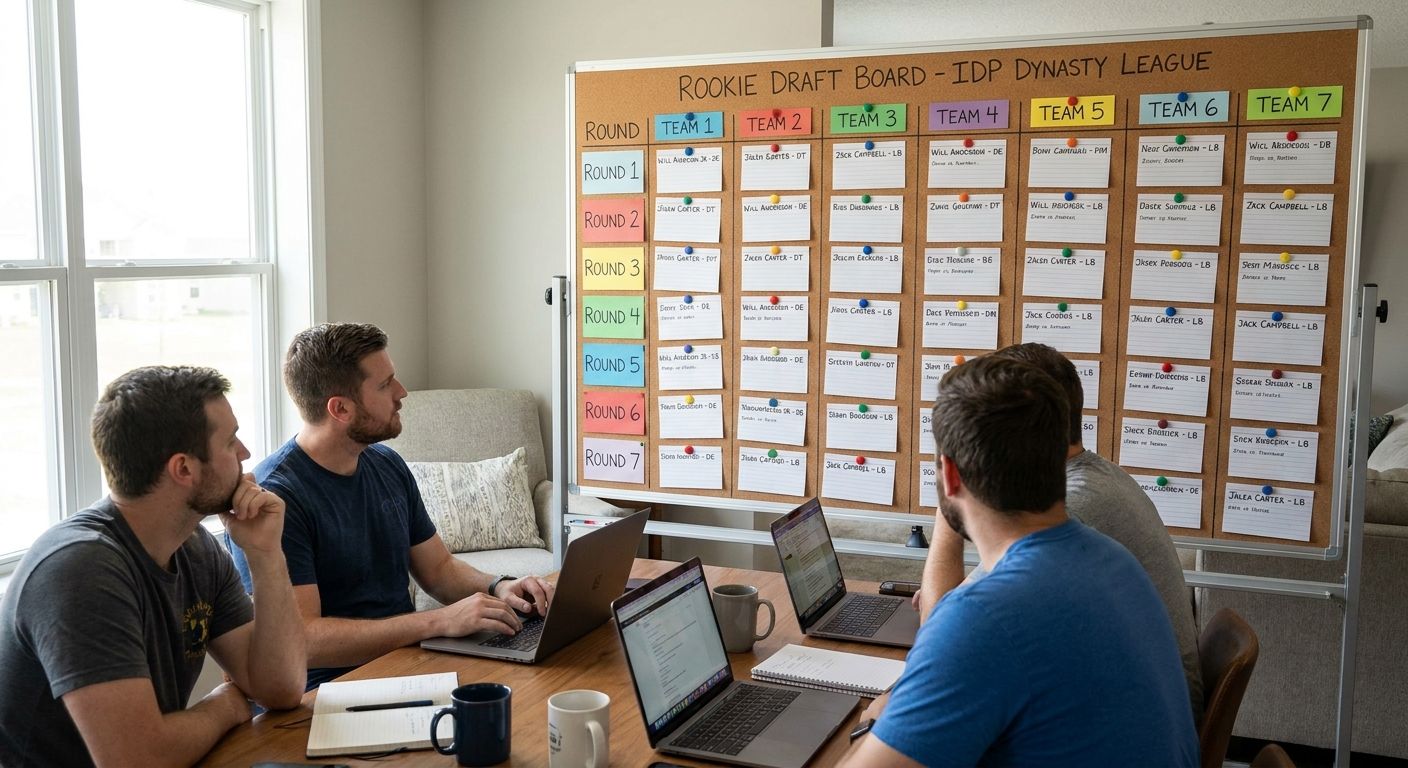
Dynasty rookie draft managers need a draft board ranked by their own league's scoring and roster rules, not a generic rookie big board copied from a national outlet. A rookie-only draft inside a dynasty league runs on different math than redraft: rookies carry no NFL box-score history, so the board lives or dies on how well it accounts for your league's IDP scoring, superflex structure, TE premium, and roster depth requirements.
- A dynasty rookie draft board must reflect your league's scoring, not national ADP averages.
- Superflex leagues push rookie QBs up multiple rounds compared to 1-QB formats — treat that as a rule, not a preference.
- IDP leagues need a separate defensive rookie tier; offense-only big boards leave that pool unranked.
- Build tiers first, then rank inside tiers — a single 1-to-150 list hides replacement-level cliffs.
- LeagueFrenzy connects to Sleeper, MFL, Fleaflicker or ESPN and rebuilds the board against your league's actual settings before the picks start.
Why this matters for dynasty rookie drafts
A rookie draft board built for a generic 12-team, 1-QB, offense-only league misranks almost every pick in a league that runs superflex, IDP, or TE premium. Move a rookie QB from a 1-QB board to a superflex board and he can jump three or four rounds without a single stat changing — the scoring format did the moving, not the player.
The same distortion hits IDP leagues running a rookie draft: national rookie rankings almost never include a defensive rookie tier, so a manager drafting off one of those boards has no ranked options once the offensive skill positions dry up. Your league's actual roster requirements — how many flex spots, whether TE gets a premium, whether IDP starts three or six — decide the board more than any single player's college tape.
Pull your league's actual roster and scoring settings first
Start with the settings page, not a rankings site. A board built before you know your own rules is a guess dressed up as a ranking.
- Confirm starting lineup slots: QB, RB, WR, TE, flex, superflex, IDP
- Note scoring multipliers: PPR value, TE premium bonus, IDP tackle/sack/INT weights
- Check bench and taxi squad size — deeper benches raise the value of late-round rookie fliers
- Record your league's roster size and number of dynasty teams, since a 10-team league has a shallower replacement level than a 14-team league
- Pull last season's actual scoring output for a few IDP and TE-premium players if your platform exports it, to sanity-check the multipliers
Set your rookie pool and strip out ADP noise
ADP mixes redraft buzz with dynasty value, and rookie ADP moves on hype cycles that have nothing to do with your scoring settings. Build your own pool before you rank anything.
- List every rookie eligible for your rookie draft, not just the ones trending on social feeds
- Cut players your league's IDP or scoring rules make unstartable (a two-way college player with no defined NFL role, for example)
- Group rookies by position group first, then merge into one board
- Flag rookies whose landing spot is still unresolved — a rookie QB in an open competition ranks differently than one in a locked-in QB1 seat
- Cross-check your pool against a custom draft cheat sheet built from your actual settings if your league runs on Sleeper, so the manual list and the settings-based one match up before you rank
Weight rookies by your league's IDP, superflex and TE premium rules
This is where a generic board and a league-aware board split hardest. A rookie tight end in a TE premium league can outrank a rookie wide receiver who would sit ahead of him in a standard-PPR format.
- In superflex leagues, move every rookie QB up relative to a 1-QB board — the replacement-level QB in superflex is a rostered starter, not a waiver name
- In IDP leagues, rank rookie defenders against your league's actual tackle, sack and turnback scoring, not a flat snap-count guess
- In TE premium leagues, apply the bonus per reception before ranking, since a small per-catch bump compounds over a 17-game season
- In standard formats, keep rookie RBs and WRs closer to consensus — this is the one format where a generic board and a league-aware one diverge least
Build tiers, not a single ranked list
A 1-to-150 numbered list hides the cliffs that actually decide draft-day trades. Tiers show you where the drop-off is, which is the information you need mid-pick.
- Group rookies into 5-8 tiers per position, not one combined tier list
- Mark the tier break where replacement-level value drops sharply — that's where a trade-down becomes worth taking
- Leave 2-3 rookies untiered if their role is genuinely unresolved, rather than forcing a rank on a guess
- Note which tier breaks shift under superflex or IDP scoring versus a standard format, since the same rookie can sit in tier 2 in one league and tier 4 in another
Stress-test the board against your holdout rounds
Hold back your first two rounds of picks and re-rank the board blind, then compare. If your gut order matches your settings-based order, the board is doing its job; if it doesn't, one of the two is wrong.
- Re-rank your top 12 rookies without looking at your first pass
- Compare the two orders and flag any player who moved more than two spots
- Check whether the movement traces back to a scoring rule you under-weighted the first time
- Repeat the holdout check after any late-breaking landing-spot news, since a role change during draft season is the single biggest reason a rookie board goes stale
Update the board the moment picks start falling
A rookie draft board is a living document during the draft window, not a file you finalize once. Every pick that falls changes replacement value for the picks behind it.
- Recheck your tiers after every 3-4 picks, not just at the turn
- Watch for runs on a single position — a run on rookie WRs thins that tier faster than your pre-draft plan assumed
- Re-rank remaining IDP rookies once the offensive skill tiers clear, since IDP boards get ignored early and picked hard late
- If your league connects through Sleeper, MFL, Fleaflicker or ESPN, LeagueFrenzy rebuilds the board live against your actual scoring rules as picks come off the board, instead of leaving you to redo the math by hand between rounds
A dynasty rookie draft board built from your league's actual scoring settings beats a generic rookie big board on every pick after the first round, because that's where superflex, IDP and TE premium rules start doing the ranking instead of raw talent.
Comparing your options
| Option | Best for | Key limitation |
|---|---|---|
| Manual spreadsheet built from settings | Managers who want full control and have time before draft day | Slow to update once picks start falling; easy to miss a scoring interaction |
| Generic published rookie rankings | A quick gut-check against national consensus | Built on 1-QB, offense-only, standard-PPR assumptions by default |
| ADP-based rookie tool | Cross-checking hype versus dynasty value | ADP blends redraft buzz with dynasty value and ignores your IDP/TE premium rules entirely |
| LeagueFrenzy custom draft board | Managers who want the board rebuilt against their league's actual scoring live during the draft | Less of an edge in plain standard-PPR leagues where a generic board already gets close |
“A rookie QB can jump three or four rounds on a superflex board without a single stat changing — the format moved him, not his tape.”
Common mistakes dynasty rookie draft managers make
- Drafting off a 1-QB board in a superflex league. The replacement-level QB in superflex is a starter, and a generic board never adjusts for that.
- Ignoring the IDP rookie pool until the offensive tiers are gone. By the time IDP gets attention, the good defensive rookies are already off the board to a manager who ranked them early.
- Trusting rookie ADP as if it were dynasty value. ADP mixes redraft hype cycles with long-term value and produces the wrong order for keeper and dynasty formats.
- Ranking TE premium rookies on a standard-PPR scale. A small per-catch bonus compounds over a season and moves a rookie TE multiple tiers.
- Finalizing the board before the draft instead of updating it pick by pick. Replacement value shifts every time a run hits a position, and a static board can't track that.
Get a board built from your league's rules
Connect Sleeper, MFL, Fleaflicker or ESPN and rank rookies by your actual scoring.
FAQ
What's the best fantasy football draft board for dynasty rookie drafts?
The best rookie draft board is one built from your league's own scoring rules — superflex, IDP, TE premium and roster size — rather than a national consensus list. A board tied to your actual settings ranks rookies correctly at every position; a generic board only gets close in plain standard-PPR formats.
Is a custom draft board better than ADP for a rookie draft?
Yes, for dynasty leagues specifically. ADP blends redraft hype with dynasty value and doesn't account for superflex or IDP scoring, so it consistently misranks rookies who benefit from your league's specific rules.
How do superflex leagues change rookie rankings?
Superflex leagues move rookie QBs up multiple rounds compared to 1-QB formats because the replacement-level quarterback becomes a rostered starter rather than a waiver-wire name. A rookie QB ranked in round three on a 1-QB board can rank in round one on a superflex board.
Do I need a separate rookie board for IDP leagues?
Yes. Most published rookie rankings are offense-only, which leaves the entire defensive rookie pool unranked. IDP leagues need rookie defenders scored against the league's actual tackle, sack and turnover rules before the draft.
How does TE premium affect rookie tight end value?
A per-reception bonus for tight ends compounds over a full season, so a rookie TE that sits mid-tier on a standard-PPR board can move up multiple tiers once the premium is applied correctly.
Should I rank rookies before or after I know my league's roster settings?
After. Roster size, bench depth and starting lineup requirements set the replacement level that decides where each rookie tier breaks, so ranking before you confirm settings means re-ranking later anyway.
How often should a rookie draft board be updated during the draft?
Recheck tiers every 3-4 picks. A run on any position thins that tier faster than a pre-draft plan accounts for, and IDP rookies especially need re-ranking once the offensive tiers clear.
Can I use the same rookie board for a keeper league?
Only if the scoring and roster rules match closely. Keeper leagues often carry different bench and taxi rules than true dynasty formats, so the tier breaks can land in different spots even with the same rookie pool.
One last thing
The single biggest gap between a generic rookie board and a league-aware one isn't the top five picks — those track consensus closely in almost every format. It's picks 8 through 20, where superflex QB runs, IDP defender tiers and TE premium bonuses each pull the order in a different direction depending on your exact settings, and that's the stretch where most dynasty managers are still drafting off a printed national list.