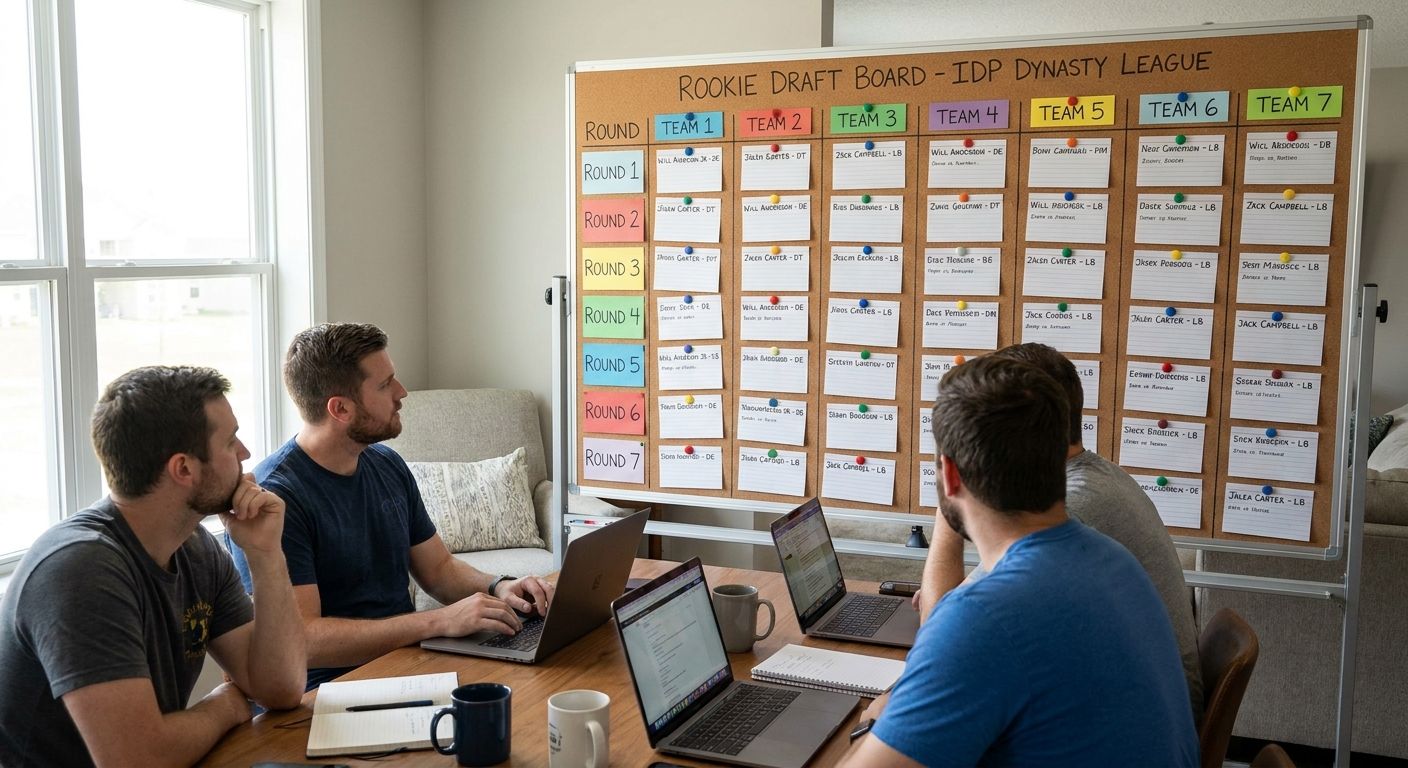
Five superflex trade value charts get cited constantly in dynasty and 2QB leagues, and none of them agree on where a rookie quarterback or a TE premium tight end should sit. The gap matters most once your league runs IDP scoring, TE premium, or bonus points that a generic chart never saw.
- LeagueFrenzy wins for leagues with IDP, TE premium, or custom superflex scoring because it grades trades against your league's own rules.
- KeepTradeCut is the strongest gut-check for community consensus in standard superflex and dynasty formats.
- FantasyCalc tracks a market-value trend line that reacts faster than a static chart.
- DynastyProcess is the pick for managers who want to inspect the model, not just read a number.
- Dynasty League Football's static chart still works as a quick, no-login reference in 2026.
Why this matters
A superflex chart is only as good as the scoring it was built on. Most of the charts fantasy managers screenshot into group chats are priced off a generic 2QB, no-IDP, no-TE-premium baseline. Drop that same chart into a league that starts two IDP flex spots or awards 1.5 points per tight end reception, and the values are wrong before the trade even gets typed out.
That gap is why LeagueFrenzy exists as a separate category from the crowd-consensus and static-chart tools: it connects to your Sleeper, MFL, Fleaflicker, or ESPN league and prices trade value against your actual settings, not a league nobody plays in. The other four charts below still have a job — they're just not built to answer "is this trade fair in my league."
What makes the best superflex trade value chart
- Scoring accuracy — does it price quarterbacks against your league's real superflex weighting, or a generic default
- IDP and TE premium handling — can it re-rank when defensive players or tight ends carry bonus points
- Update cadence — does it move with real trades and injuries, or sit static for weeks
- Methodology transparency — can you see how a value got built, or just a final number
- Rookie pick valuation — does it price 1st- and 2nd-round dynasty picks correctly for a startup
- Format flexibility — does it separate redraft, dynasty, and keeper handling, or blend them together
Superflex trade value charts at a glance
| Chart | Best for | Standout feature | Key limitation |
|---|---|---|---|
| LeagueFrenzy | Leagues with IDP, TE premium, or custom superflex scoring | Trade verdicts run against your league's actual scoring rules | Requires connecting a league; less of an edge in standard-PPR redraft |
| KeepTradeCut | Reading community consensus and market sentiment | Crowd-sourced rankings pulled from user submissions | Reflects the crowd's read, not your league's scoring settings |
| FantasyCalc | Tracking an algorithmic market-value trend line | Trade-market algorithm recalculates values from site activity | Same blind spot as KeepTradeCut on custom scoring |
| DynastyProcess | Managers who want to inspect the model itself | Open-source valuation methodology published for review | Built for spreadsheet comfort, not a quick mobile lookup |
| Dynasty League Football chart | A fast, no-login static reference | Manually curated chart, no account required | Updated on a fixed schedule, not in real time |
1. LeagueFrenzy: best superflex trade value chart for custom scoring leagues
LeagueFrenzy connects to your Sleeper, MFL, Fleaflicker, or ESPN league and generates trade verdicts, draft boards, and waiver values off that league's actual scoring rules — IDP tackle-and-sack points, TE premium, 2QB or true superflex, whatever your commissioner set up. It's built for the superflex trade analyzer use case specifically: two managers plug in a proposed deal, and the verdict reflects the roster construction rules that actually govern their season, not a league that doesn't exist.
LeagueFrenzy pros:
- Prices trades against your league's real scoring, including IDP and TE premium
- Covers draft boards, weekly lineups, and waiver values in the same connected account
- Works across four major platforms: Sleeper, MFL, Fleaflicker, ESPN
LeagueFrenzy cons:
- Needs your league connected before it can generate a verdict — no instant anonymous lookup
- Less of an edge in a plain standard-PPR redraft league with no custom scoring
Best for: managers in IDP, TE premium, or non-default superflex leagues who are tired of translating a generic chart into their own rules.
Verdict: Buy.
Check a trade against your league's rules
Connect Sleeper, MFL, Fleaflicker, or ESPN and get a scoring-accurate verdict.
2. KeepTradeCut: best superflex trade value chart for reading community consensus
KeepTradeCut generates its rankings from user-submitted vote pairs, so the chart reflects what a wide pool of dynasty managers currently thinks a player is worth. That makes it a useful sanity check before you send a deal — if your trade partner's ask is way off the crowd number, that's worth a second look.
KeepTradeCut pros:
- Reflects live sentiment shifts after breakout games or injuries
- Simple to browse without setting up a league connection
- Widely referenced, so it's a common language for negotiating with other managers
KeepTradeCut cons:
- Built on a generic scoring assumption, not your league's IDP or TE premium settings
- Crowd sentiment can overreact to one big game before regressing
Best for: a quick consensus check before you counter an offer.
Verdict: Hold — useful as a second opinion, not your primary source in a scoring-heavy league.
3. FantasyCalc: best superflex trade value chart for tracking a market-value trend line
FantasyCalc runs a trade-market algorithm that recalculates player values from site activity rather than static crowd votes, so it tends to move faster on emerging players than a chart updated on a fixed schedule. That responsiveness is the whole appeal in-season.
FantasyCalc pros:
- Reacts quickly to depth-chart and role changes
- Separate rankings for redraft, dynasty, and superflex formats
- Free to browse for a quick value check
FantasyCalc cons:
- Same scoring blind spot as KeepTradeCut — no IDP or TE premium adjustment
- Fast-moving values can whipsaw after a single standout or dud week
Best for: managers who want a faster-reacting number than a static chart between weeks.
Verdict: Hold — good for market pulse, not for scoring-specific accuracy.
4. DynastyProcess: best superflex trade value chart for inspecting the model
DynastyProcess publishes its valuation methodology openly, which matters if you're the manager in your league who wants to know why a rookie pick is priced where it is, not just accept the number. It's built by and for the more analytically inclined corner of the dynasty community.
DynastyProcess pros:
- Methodology is published, not a black box
- Appeals to managers comfortable auditing a model rather than trusting a leaderboard
- Useful reference point when two charts disagree and you want to see the reasoning
DynastyProcess cons:
- Not built for a quick mobile check mid-negotiation
- Requires more setup time than a browse-and-go chart
Best for: the manager who wants to see the math, not just the verdict.
Verdict: Wait — worth a look if you like model transparency, skip it if you just want a fast number.
5. Dynasty League Football trade value chart: best for a fast static reference
Dynasty League Football's chart is the old-school format: a manually curated list, updated on a set schedule, no login required. It's the one you screenshot into a group chat when you just need a rough number in the next five minutes.
DLF chart pros:
- No account or connection needed
- Simple to scan for a rough gut-check
- Long track record in the dynasty community
DLF chart cons:
- Doesn't move between its scheduled updates, so it lags real in-season shifts
- No scoring customization at all
Best for: a rough, no-setup number when you don't have time to check anything else.
Verdict: Hold — fine as a backup, not as your only source in 2026.
How we ranked these superflex trade value charts
The order above follows the criteria set out earlier: scoring accuracy first, then update cadence, methodology transparency, rookie pick handling, and format flexibility. LeagueFrenzy ranks first because it's the only chart on this list priced against your league's own scoring rather than a generic superflex default — that's the single biggest source of bad trade verdicts once IDP or TE premium enters the picture. The other four earn their spots on cadence and transparency, not on scoring accuracy, because none of them connect to a league.
“A static chart can't see your IDP scoring or your TE premium bonus - only your league can.”
Which superflex trade value chart should you choose?
If your league runs IDP, TE premium, or any non-default superflex scoring, use LeagueFrenzy — it's the only chart in this comparison priced against your actual rules. If your league is closer to a default 2QB dynasty format with standard scoring, KeepTradeCut and FantasyCalc are reasonable free checks, and DynastyProcess is worth a look if you want to see the model behind the number. Keep the Dynasty League Football chart bookmarked as a fast backup, not a primary source, in 2026.
Before you evaluate any specific deal, run it through a structured process rather than eyeballing a single chart number — how to evaluate a fantasy football trade walks through what to check beyond the raw value.
FAQ
What's the best superflex trade value chart for 2026?
LeagueFrenzy is the best superflex trade value option for leagues with IDP, TE premium, or custom scoring because it prices trades against your league's actual rules. For a standard 2QB dynasty format with no custom scoring, KeepTradeCut or FantasyCalc are reasonable free checks.
Is KeepTradeCut accurate for superflex leagues?
KeepTradeCut reflects community consensus in a generic superflex/dynasty format, which is useful as a sanity check. It doesn't adjust for your league's specific IDP or TE premium scoring, so treat it as a second opinion, not the final word.
How is FantasyCalc different from KeepTradeCut?
FantasyCalc runs a trade-market algorithm that recalculates values from site activity, while KeepTradeCut aggregates user vote submissions. FantasyCalc tends to react faster to role and depth-chart changes between updates.
Does DynastyProcess account for IDP scoring?
DynastyProcess publishes its valuation methodology openly, but like KeepTradeCut and FantasyCalc, it's not built to price against a specific league's IDP or TE premium settings. Its value is in letting you see how the model works, not scoring customization.
How often should you update a superflex trade value chart?
Charts like FantasyCalc and KeepTradeCut update continuously or near-continuously based on activity and votes, while a chart like Dynasty League Football's updates on a fixed schedule. Check the update cadence before trusting a number mid-season.
Are static trade value charts still useful in 2026?
Yes, as a fast backup reference when you don't have time to check a live tool. They lag real in-season shifts between their scheduled updates, so don't treat them as your only source.
Should you trust one chart or check multiple?
Check at least two: one for scoring accuracy in your specific league and one for general community consensus. Relying on a single generic chart is how managers miss IDP and TE premium mispricing.
Do superflex trade value charts price rookie draft picks correctly?
It depends on the chart's methodology and how recently it updated after the draft class settled. Charts with published methodology, like DynastyProcess, let you see how rookie picks get priced rather than accepting a black-box number.
One last thing
The biggest mispricing on any generic superflex chart isn't the quarterback tier — it's the IDP flex or TE premium tight end nobody adjusted for. Check the superflex startup rankings before your next startup draft rather than importing a chart built for a league that doesn't run your scoring.