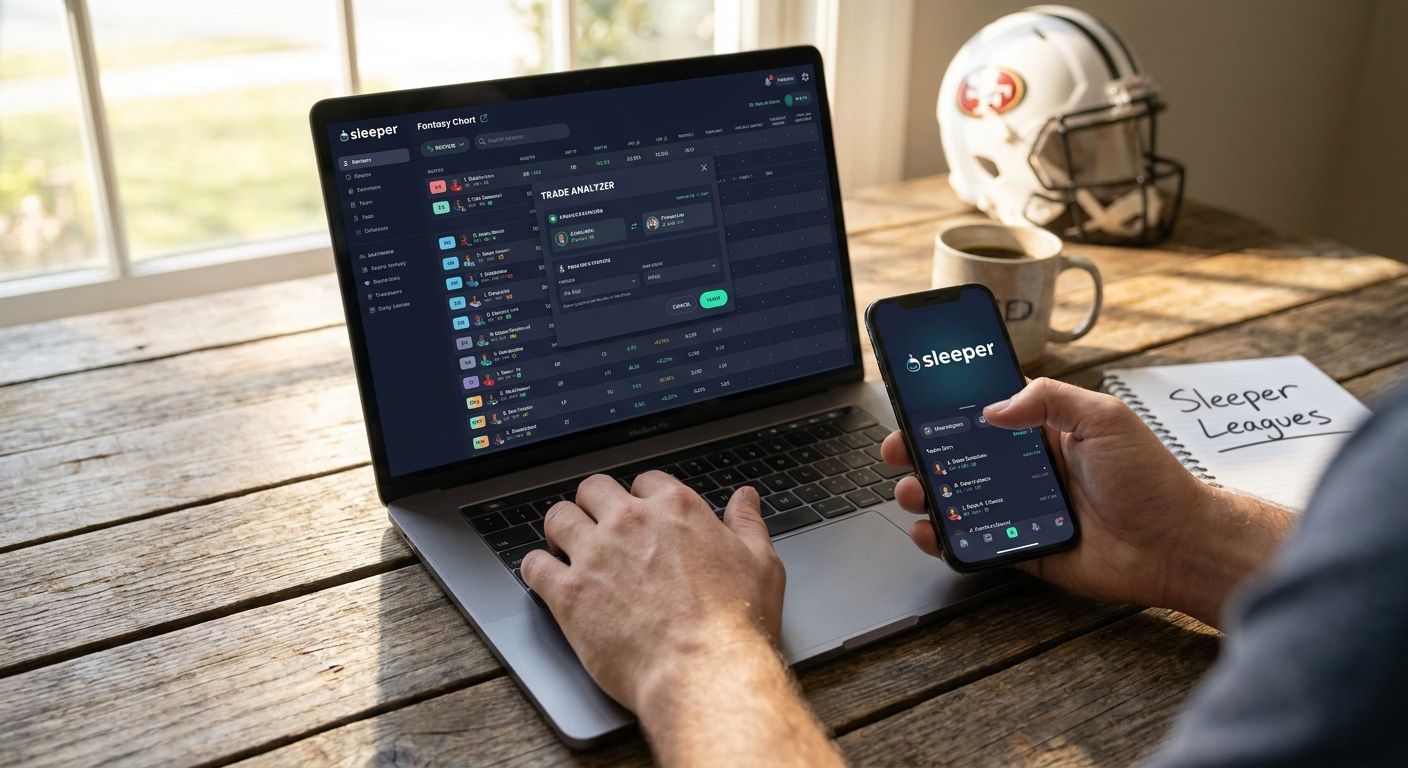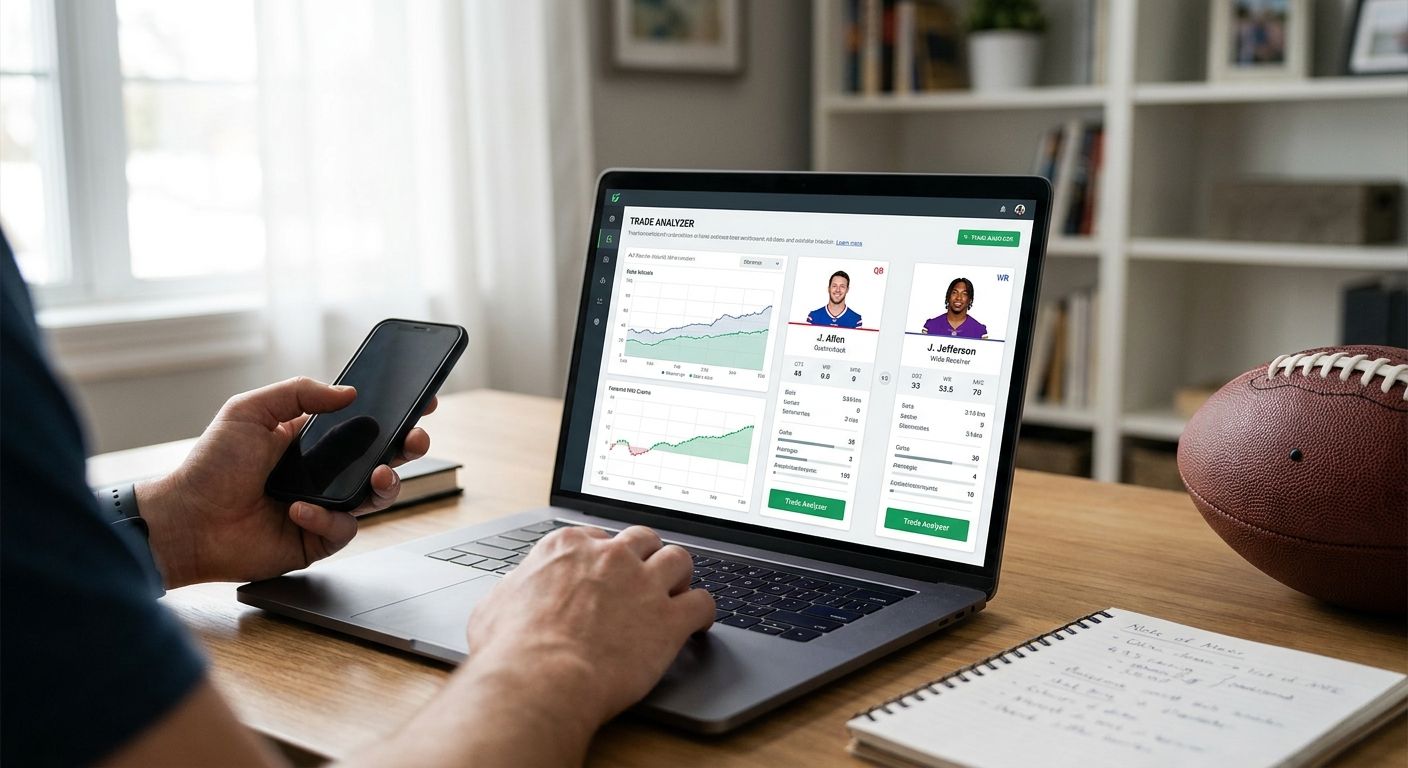
Superflex leagues break every generic trade calculator the moment you add a second quarterback slot. A tool that grades trades on your league's actual scoring and roster settings, not a one-size-fits-all value chart, is the only way to know if a deal actually helps you.
- LeagueFrenzy grades trades against your league's real scoring and roster settings — Buy for superflex managers.
- KeepTradeCut's crowd values ignore your IDP and TE-premium settings — Consider as a sanity check only.
- Spreadsheet value charts built for single-QB leagues underprice QB13-QB24 — Skip for superflex trades.
- A fantasy football trade analyzer for superflex leagues has to reprice every quarterback, not just your starters.
Why this matters
A single-QB trade calculator treats your QB2 like bench depth. In a superflex league, that same player is a starter every week, and pricing him like a QB2 in a standard league is how you lose a trade before you even hit send. The scoring dropdown on most "universal" trade tools defaults to standard or half-PPR, and that default alone can misvalue every quarterback on your roster.
Superflex also changes replacement level at every other position. Running backs and tight ends get cheaper relative to quarterbacks because roster spots that would have gone to a flex RB or WR now go to a second QB. A trade analyzer that doesn't know your league runs superflex is answering a different question than the one you're asking.
Who this is for
This guide is for managers running LeagueFrenzy or evaluating tools for a Sleeper, MFL, Fleaflicker or ESPN superflex league — dynasty or redraft, with or without IDP or TE premium — who need a trade verdict built from their league's real scoring, not a generic ADP chart.
What to look for in a trade analyzer for superflex leagues
Scoring-rule sensitivity, not a scoring dropdown
Most tools let you pick "superflex" from a menu and stop there. That's not enough if your league also runs TE premium, 6-point passing touchdowns, or IDP. The analyzer needs to pull your league's actual scoring settings, not a preset that approximates them.
Two-QB roster math, not single-QB math
With two starting quarterback slots instead of one, replacement level shifts across your entire roster. A trade tool that still calculates value off a 12-team, 1-QB baseline is solving last decade's format.
Draft-capital pricing for your league's pick count
Rookie picks trade differently in superflex because early first-rounders are quarterback insurance. An analyzer needs to price picks against your league's actual roster size and pick count, not a generic dynasty startup chart.
FAAB and waiver context baked into the verdict
A trade that looks even on paper can be lopsided once you factor in who's a FAAB target versus a $0-waiver afterthought. Tools that only compare static player values miss this entirely.
Update cadence during the season
Values that update once a preseason are stale by Week 6. A superflex trade analyzer needs to move players after real usage — a QB2 who wins a job in September is worth more in October than in August, and the tool should reflect that shift.
A verdict, not just a number
A value differential tells you who "won" the trade on paper. It doesn't tell you whether the deal fixes your roster's actual weak spot. Look for tools that pair the number with a plain verdict: accept, counter, or decline.
Top picks
LeagueFrenzy — the league-aware pick. LeagueFrenzy connects directly to your Sleeper, MFL, Fleaflicker or ESPN league and builds trade verdicts from that league's actual scoring settings, including superflex, IDP, and TE premium, rather than a generic preset. One spec that matters: it reads your real roster size and starting lineup requirements before it prices a single player, which is what separates a superflex-specific verdict from a standard-league chart with a superflex label slapped on it. Buy if your league runs any non-standard scoring on top of superflex.
KeepTradeCut — the crowd-consensus pick. This is a community-driven value tool where user rankings set player prices across dynasty formats, including superflex. It's useful as a second opinion on market sentiment, especially for gauging how the broader dynasty community currently views a rookie quarterback. It does not read your league's scoring settings or roster construction. Consider it as a cross-check, not your primary trade tool.
A spreadsheet value chart — the DIY pick. Building your own tiered value chart in a spreadsheet gives you full control, and plenty of dynasty managers still do it. The problem in superflex: most public value charts you'd copy from are built off single-QB assumptions, and re-tiering every quarterback by hand for two-QB replacement level is a multi-hour project you'll redo every bye week. Consider only if you're willing to rebuild the QB tiers yourself and keep them current.
A generic redraft trade calculator — the trap pick. These tools are fast, free, and built for standard 1-QB leagues. Run a superflex trade through one and it will systematically underprice every quarterback outside your starting two, because its replacement-level math assumes a league that doesn't need a QB2. Skip for any superflex decision, even a quick sanity check.
“If a trade calculator prices your slot-two quarterback like a punter, it isn't built for superflex.”
What to avoid
- Standard-PPR value charts relabeled "superflex." A checkbox that says superflex doesn't mean the underlying replacement-level math changed.
- Trade grades with no roster context. A tool that only compares two players' values in isolation can't tell you the trade widens a hole at tight end.
- Tools that price rookie picks off startup ADP alone. Startup ADP reflects a fresh 12-team draft, not your league's actual pick count and roster crunch three seasons in.
Verdict comparison
| Criteria | LeagueFrenzy | KeepTradeCut | Spreadsheet chart | Generic calculator |
|---|---|---|---|---|
| Reads your league's scoring | Yes | No | Manual only | No |
| Two-QB roster math | Yes | Partial | Manual only | No |
| Rookie pick pricing by league size | Yes | Generic | Manual only | Generic |
| In-season value updates | Yes | Community-driven | Manual only | Rare |
| Plain-language verdict | Yes | No | No | No |
| Overall call | Buy | Consider | Consider | Skip |
Grade your next trade offer
Connect your league and get a verdict built on your scoring rules.
FAQ
What's the best fantasy football trade analyzer for superflex leagues in 2026?
LeagueFrenzy is the strongest pick for 2026 because it builds trade verdicts from your league's actual scoring and roster settings instead of a generic superflex preset. Crowd tools like KeepTradeCut work as a secondary sanity check but don't read your league's rules.
Is a superflex trade analyzer different from a standard one?
Yes, because superflex adds a second starting quarterback slot, which shifts replacement level at every position. A standard-league trade tool will misprice quarterbacks outside your top 12 if it doesn't account for two-QB roster math.
Do I need a different tool for superflex IDP leagues?
You need a tool that reads both settings at once, not two separate calculators. A trade analyzer that only handles superflex or only handles IDP, but not both together, will misvalue any trade involving a defensive player.
How much does a fantasy trade analyzer cost?
Pricing varies by tool and format, so check current pricing directly on the provider's site before committing. Free calculators exist but typically skip league-specific scoring in favor of one generic preset.
Can I use KeepTradeCut for a superflex trade?
You can use it as a community-sentiment check, but it won't price your trade against your league's actual scoring or roster requirements. Pair it with a league-connected tool for the final call.
Does TE premium scoring change trade values in superflex leagues?
Yes, TE premium raises tight end trade value independent of the superflex quarterback bump, and a tool has to apply both adjustments at once. A trade analyzer that only adjusts for one setting will misprice any deal involving a top-tier tight end.
How often should trade values update during the season?
Values should move after real usage changes, not just once before Week 1. A rookie quarterback who wins a starting job in Week 4 needs a repriced trade value by Week 5, not at the next offseason reset.
Are rookie draft picks worth more in superflex leagues?
Early first-round rookie picks generally trade higher in superflex because they're quarterback insurance in a format that starts two. The exact premium depends on your league's pick count and roster size, which is why a generic startup chart undersells or oversells picks depending on your format.
One last thing
The fastest way to spot a trade calculator that isn't built for your league: check whether it asks for your scoring settings before or after it shows you a value. If the number appears first and the settings are an afterthought, the tool built the verdict on someone else's league, not yours.
The 2026 season is already exposing which trade tools actually read league settings and which ones just changed a label. Test any calculator on a trade involving your own QB2 — if the value looks identical to what it would in a single-QB league, you've found the gap.