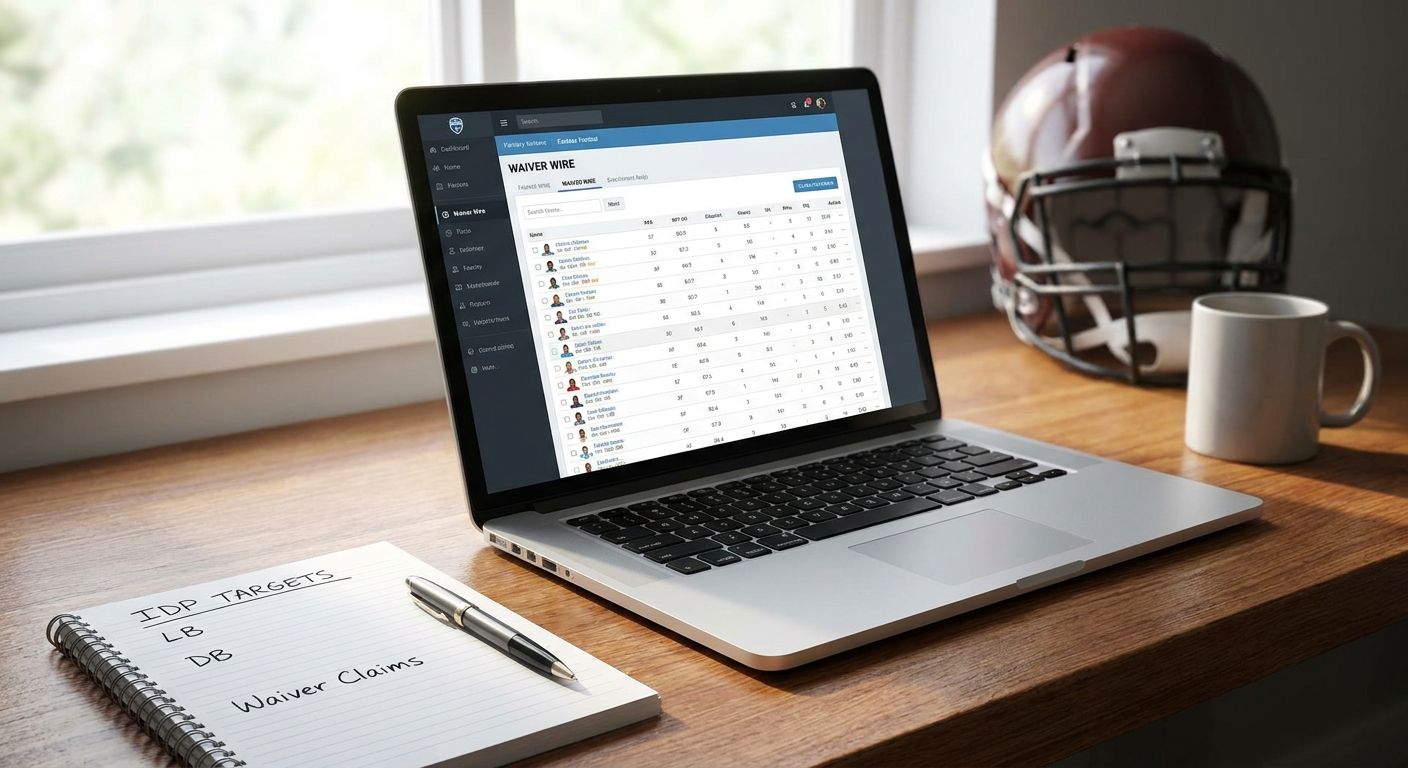
IDP waiver wire strategy is the weekly process of ranking free-agent defenders by your league's actual tackle, sack, and turnover scoring instead of generic snap-count hype, with the aim of turning FAAB budget into points your specific rules reward. Standard-PPR waiver advice treats a linebacker like a linebacker; a league running big-play IDP bonuses or a tackle-heavy solo/assist split treats the same player as a top-12 add or a bench stash, and the gap between those two reads is where most managers waste FAAB.
- Waiver wire strategy for IDP leagues starts with your league's scoring split, not national snap-count rankings.
- LeagueFrenzy grades 815 players against actual IDP scoring rules across 8 published seasons of accuracy.
- FAAB bids on IDP free agents should track positional scarcity, not box-score streaks from Week 1.
- A tackle-heavy league and a big-play league can rank the same linebacker 40 spots apart in 2026.
Why waiver wire strategy matters for IDP leagues
IDP scoring splits vary enough between leagues that a top-15 add in one format sits on the wire in another. A league paying 1.5 points per solo tackle and 0.5 for assists rewards a downhill run-stopping linebacker; a league paying flat 1 point per tackle regardless of solo/assist rewards volume tacklers who rack up garbage-time stats in blowouts. Neither read is wrong — but a generic IDP1 ranking published for the average league gets one of them wrong every time.
The bigger issue in 2026 is that most waiver tools still rank IDP the same way they rank kickers: an afterthought bolted onto an offense-first model. If your league runs IDP with defensive scheme changes, snap-share shifts, and bye-week roulette, you need a waiver process built around those variables, not a top-50 list copy-pasted from a standard-scoring site.
Audit your league's IDP scoring rules before Week 1 claims start
Most managers set their waiver priorities off memory instead of the actual scoring page, and the two rarely match by December.
- Confirm your points-per-tackle split (solo vs. assist vs. combined)
- Check if your league scores tackles for loss separately from solo tackles
- Note whether sacks, forced fumbles, and INTs carry bonus multipliers
- Confirm defensive TD and safety scoring if your league runs those
- Flag any big-play thresholds (10+ yard tackle bonuses are common in DL-heavy formats)
Track snap counts and scheme changes weekly, not monthly
A linebacker's raw tackle total means less than his snap share inside the specific defensive front he plays in. Scheme changes after a coordinator firing can shift a role player into a starter in a single week.
- Pull snap-count percentage for every rostered and available IDP, updated weekly
- Flag any defensive coordinator change inside the last 14 days
- Watch for injuries to starters ahead of your target on the depth chart
- Track sub-package usage for pass-rushing specialists who don't play early downs
Prioritize positional scarcity over box-score chasing
A linebacker who racks up 12 tackles in a blowout loss is not automatically a better add than a 7-tackle, 1.5-sack edge rusher if your league is short on productive DL depth league-wide.
- Rank waiver targets by position-specific replacement level, not overall IDP points
- Check your league's rostered IDP by position to see where the wire is thin
- Weight sacks and TFLs higher in leagues that reward big plays over volume
- Avoid claiming a third linebacker when your league only starts one
Build your FAAB budget around byes and injuries, not hot streaks
A two-tackle, one-sack week from a rookie edge rusher is not proof of a role change — check the snap count before you spend 15% of your FAAB on it.
- Reserve 20-30% of season FAAB for Weeks 6-10, when byes create the deepest wire
- Bid conservatively on one-week spike performances unless snap share also spiked
- Save a bidding reserve for post-trade-deadline role changes in late October
- Track your remaining FAAB against remaining bye weeks so you don't run dry early
Time your claims around practice reports and depth-chart news
Waiver deadlines usually land before Sunday news catches up, so managers who wait for box scores are a week behind managers who track practice participation.
- Check Wednesday and Thursday practice reports for starters listed as limited
- Watch for backup defenders getting first-team reps in practice
- Claim ahead of an announced starter change instead of after the first box score
- Cross-check beat-writer notes against your league's actual scoring impact
Cross-check every waiver target against your bench and trade needs
Adding a fourth linebacker you'll never start burns FAAB you needed for a trade-deadline push. A fantasy football trade analyzer built for IDP leagues can flag whether a roster hole is better solved on the wire or in a deal before you spend bid money you can't get back.
- List your bench IDP by position and mark true bye-week fills vs. dead weight
- Compare a waiver add's rest-of-season outlook against a trade target at the same position
- Hold FAAB reserve if a trade conversation is already open at that position
- Drop the lowest-scoring bench IDP before adding a fourth at the same spot
Use a scoring-specific tool to rank claims once your process is set
Manual tracking works, but it's slow once your league runs a non-standard IDP split with tackle-for-loss bonuses or a big-play threshold. LeagueFrenzy connects to your Sleeper, MFL, Fleaflicker, or ESPN league and re-ranks the wire against your league's actual scoring rules instead of a generic IDP1 list.
- Sync your league so waiver values reflect your exact tackle/assist/sack weighting
- Check platform-specific waiver values for Sleeper leagues or ESPN leagues
- Compare tool output against your own snap-count notes before bidding
- Re-check values after any scheme or depth-chart change, not just once a week
Waiver wire strategy for IDP leagues works when the ranking reflects your league's tackle-and-sack math, not a standard-scoring proxy someone else built.
Rank IDP waivers by your scoring
Connect your league and see waiver values built on your actual tackle and sack rules.
Comparing waiver wire options for IDP leagues
| Option | Best for | Key limitation |
|---|---|---|
| National expert IDP rankings | Managers wanting a quick gut-check | Built for average scoring, not your split |
| Spreadsheet snap-count tracking | Detail-oriented managers with time to spare | Time-intensive, no scoring-weighted output |
| Generic waiver wire app | Managers in standard-PPR-plus-IDP hybrids | IDP treated as an afterthought behind offense |
| League-specific waiver tool (LeagueFrenzy) | Managers in custom or big-play IDP formats | Less edge in vanilla standard-PPR-only leagues |
Verdict: national IDP rankings are a fine starting point, but a manager in a tackle-for-loss or big-play IDP league needs a scoring-specific re-rank before bidding FAAB.
Common mistakes IDP managers make on waivers
- Chasing tackle totals without checking snap share — a 10-tackle game from a rotational player rarely repeats.
- Copying a generic IDP1 list into a scoring format it wasn't built for — big-play and volume leagues rank the same player differently.
- Blowing FAAB on a Week 3 spike before confirming the role change is real.
- Ignoring positional scarcity — adding a third or fourth linebacker while your DL corps starves.
- Skipping the trade market entirely — a roster hole filled by trade can save FAAB a waiver claim would burn; run the numbers with how to evaluate a fantasy football trade before defaulting to the wire.
LeagueFrenzy's published IDP holdout — 0.600 across graded seasons — comes from testing rankings against actual scoring outcomes, not projections. That number matters here because it means the gap between a generic IDP ranking and a league-specific one isn't cosmetic; it shows up in which players actually score points in your format.
FAQ
What's the best waiver wire strategy for IDP leagues in 2026?
Rank available defenders against your league's exact scoring split — solo vs. assist weighting, tackle-for-loss bonuses, and big-play thresholds — instead of a generic IDP1 list. Snap-count trends and depth-chart news should drive FAAB bids more than last week's box score.
How much FAAB should I spend on an IDP waiver claim?
Reserve 20-30% of season FAAB for the bye-week stretch between Weeks 6 and 10, when the wire is deepest. Bid conservatively on single-week spikes unless snap share also increased.
Is snap count more important than tackle total for IDP waivers?
Yes, snap share predicts future production better than a single week's tackle count. A player with rising snap percentage is a stronger long-term add than one coming off a one-week tackle spike in a low-snap role.
Should I claim IDP players before or after a scheme change is announced?
Claim ahead of the announcement when practice reports or beat-writer notes signal a role change. Waiting for the first box score after a scheme shift usually means you're bidding against managers who already moved.
Do generic fantasy football waiver tools work for IDP leagues?
They work for standard offensive positions but usually treat IDP as a secondary feature built on average scoring assumptions. A tackle-for-loss or big-play IDP league needs values re-ranked against its own scoring rules, which is what a league-specific tool like LeagueFrenzy is built to do.
How is IDP waiver strategy different from offensive waiver strategy?
Offensive waivers track target share and red-zone usage; IDP waivers track snap share, scheme fit, and scoring-specific bonuses like tackles for loss. The scoring variance between leagues is also much wider for IDP than for standard offensive scoring.
Should I trade for an IDP instead of using a waiver claim?
Trade when a roster hole is deep enough that FAAB alone won't fix it, especially at a scarce position like edge rusher. Compare the waiver cost against a trade offer before committing bid money you can't recover.
One last thing
The managers who win IDP waiver wars in 2026 aren't the ones with the biggest FAAB budget — they're the ones checking practice reports on Wednesday instead of box scores on Monday. A scoring-specific waiver rank only helps if you're bidding on the right week's information.