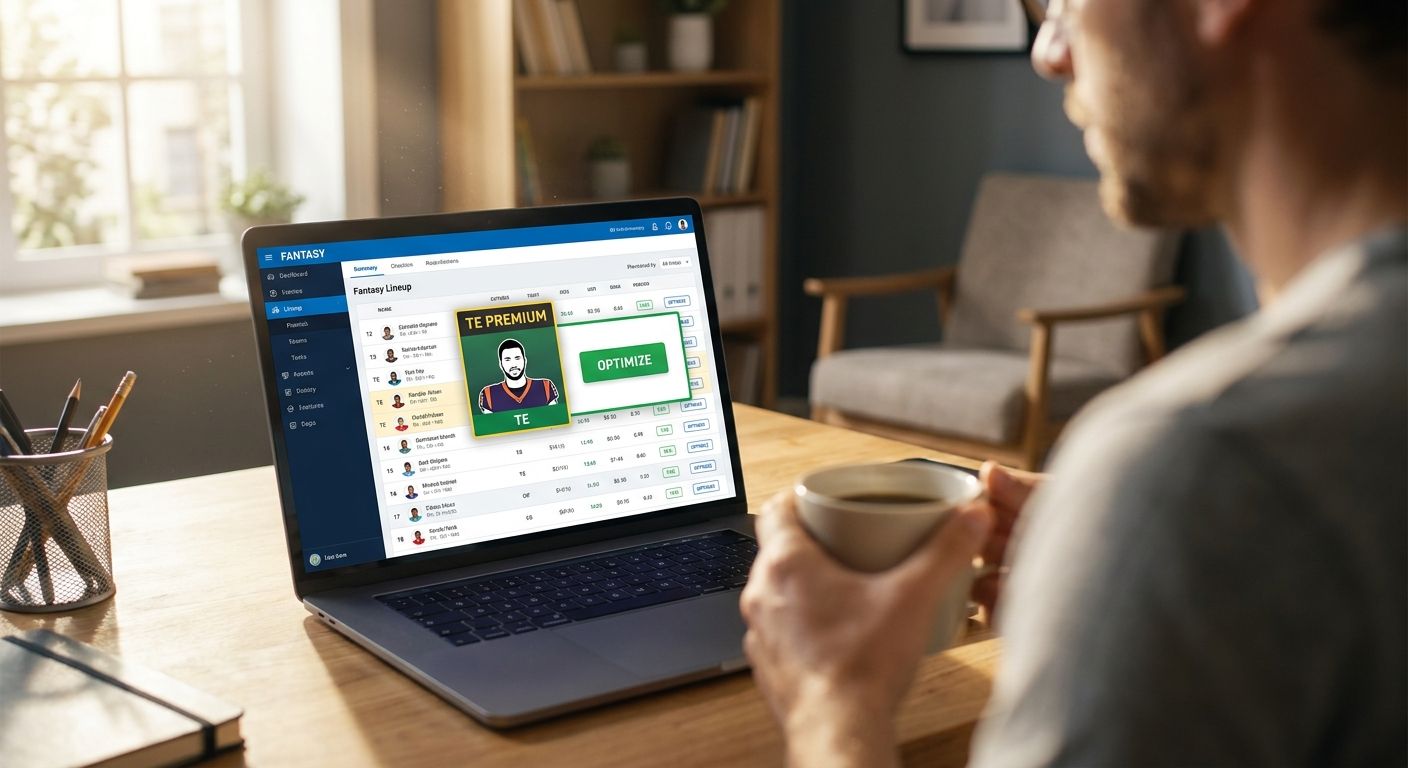
A lineup optimizer for TE premium leagues ranks your weekly starts against your league's actual tight end scoring bonus, not against a generic PPR expected-points sheet, so you stop benching a tight end who is quietly outscoring your flex. TE premium leagues typically add 0.5 to 1.0 extra points per reception at the position, and that bonus rewrites replacement level in ways a standard optimizer never sees.
- A 0.5-per-catch TE bonus can swing 4-6 points a week between your TE2 and a generic flex play.
- Generic PPR rankings undervalue tight ends in TE premium leagues because they score the position at 1.0 PPR, not your league's rate.
- LeagueFrenzy builds a lineup optimizer for TE premium leagues from your connected league's exact scoring rules, not consensus averages.
- Manual fix: rebuild expected points using your league's TE bonus before you touch the flex slot.
- Streaming a route-runner tight end in a 1.0 TE premium league often beats a low-target RB3 off waivers.
Why lineup optimization matters for TE premium leagues
Most fantasy content, including the projections built into Sleeper and ESPN's native tools, is written for standard or 1.0 PPR scoring. Add a TE premium bonus and the gap between a mid-tier tight end and a low-end flex option narrows or disappears entirely. A tight end catching 6 passes in a 0.5 TE premium league picks up 3 extra points before touchdowns are even counted; that same catch total means nothing in a standard-PPR sheet.
This is a roster-construction problem, not a rankings problem. Your league's exact bonus, roster requirements, and flex-eligibility rules decide who should start every week, and no generic tool asks what your league does at tight end before spitting out a lineup.
The core issue: a lineup optimizer for TE premium leagues has to start from your league's scoring settings, or the ranking underneath it is wrong before you ever open the app. LeagueFrenzy connects directly to Sleeper, MFL, Fleaflicker, or ESPN and pulls your league's actual TE bonus into every weekly lineup call.
Confirm your league's exact TE scoring bonus
Before you touch a single lineup, verify the number. Leagues labeled "TE premium" are not standardized, and the difference between 0.5 and 1.0 per catch changes who clears your flex bar.
- Check your league's scoring settings page for the tight end reception value specifically, not the flat PPR number
- Note whether the bonus applies to all catches or only catches over a route-depth threshold (rare, but some custom leagues do this)
- Confirm whether your flex slot is FLEX (RB/WR/TE) or SUPERFLEX-style, since a wider flex changes who competes with your TE2
- Write the number down somewhere you'll see it weekly — a surprising number of managers guess wrong on their own league's bonus
Rebuild your flex tier around the TE bonus
Once you know the bonus, your flex rankings need a manual adjustment before you trust any outside source.
- Add the TE bonus times projected receptions to every tight end's baseline projection
- Re-sort your flex-eligible players (RB, WR, TE) by the adjusted total, not the position-blind consensus rank
- Flag any tight end who jumps into your top-6 flex options — this is usually where a bench TE has been underused
- Repeat weekly, since target share and game script shift this ranking more than raw talent does
Track target share and route rate, not touchdowns
Touchdown-dependent tight ends are volatile in any scoring format, but TE premium leagues reward volume regardless of the end zone.
- Pull snap counts and route participation from the prior week's box score before setting Sunday's lineup
- Weight target share over touchdown total when two tight ends are close in projection
- Watch for a backup tight end absorbing more routes after an injury — this shows up in target share a week before consensus rankings adjust
- Discount touchdown-only tight ends by roughly one tier in TE premium formats, since their weekly floor is lower once you remove the score
Re-rank your bench tight ends against your flex weekly
Most managers rank tight ends once in August and never touch it again. In a TE premium league that's a mistake, because a TE2's weekly value moves relative to your flex options, not in isolation.
- Compare your bench TE's adjusted score directly against your worst starting flex player every single week
- Move a bench tight end into the flex the moment his adjusted total passes your flex floor for two straight weeks
- Check bye weeks separately — a TE premium bonus makes a streaming tight end viable during your starter's bye in a way standard scoring rarely does
- If you roster two startable tight ends, treat the second one as a flex candidate, not a bench stash
Set your lineup against a scoring-aware optimizer instead of generic rankings
This is where doing it by hand starts to cost real time, and where a tool built for your league's exact rules earns its keep. A generic optimizer app applies one scoring template to every league it touches; it has no way to know your bonus is 0.75 per catch instead of 0.5. LeagueFrenzy's lineup optimizer for TE premium leagues pulls your connected league's scoring settings automatically and re-ranks your roster against them every week, the same way it handles superflex lineup construction for leagues that start two quarterbacks.
- Confirm the tool reads your league's scoring rules directly from Sleeper, MFL, Fleaflicker, or ESPN rather than asking you to input a template
- Check that flex recommendations update when injury reports or snap counts shift midweek
- Verify waiver-wire suggestions carry the same TE premium adjustment as the lineup calls — a disconnect between the two means the tool is only half-built for your format
- Compare its output against your manual adjusted rankings for two weeks before trusting it blind
Audit your waiver priorities for streaming tight ends
TE premium leagues make streaming a viable strategy at a position most managers set and forget.
- Rank available tight ends by projected route share, not name recognition
- Prioritize a bye-week streamer over a marginal RB4 add when your league's TE bonus is 0.75 or higher
- Watch for a committee backfield opening up target volume to a receiving tight end mid-season
- Don't burn FAAB on a touchdown-dependent tight end streamer; volume wins the format more consistently
Connect your TE premium league
Get a lineup optimizer built from your league's exact scoring rules, not a generic template.
Comparison: lineup optimizer options for TE premium leagues
| Option | Best for | Key limitation |
|---|---|---|
| Manual spreadsheet rebuild | Managers who want full control over the TE bonus math | Takes 20-30 minutes a week and misses midweek snap changes |
| Generic optimizer app | Standard or 1.0 PPR leagues without a custom TE bonus | Applies one scoring template to every league, ignoring your actual TE premium rate |
| Platform-native projections (Sleeper, ESPN) | Quick sanity checks on injury status | Projects to a default scoring format, not your league's settings |
| LeagueFrenzy | TE premium leagues connected via Sleeper, MFL, Fleaflicker, or ESPN | Less of an edge in plain standard-PPR leagues with no scoring quirks |
Verdict: a spreadsheet works if you'll actually rebuild it every week; a scoring-aware tool like LeagueFrenzy wins on time and consistency once your league's TE bonus is anything other than standard.
Common mistakes TE premium managers make
- Using a 1.0 PPR cheat sheet as-is. A cheat sheet built for standard PPR undervalues every tight end in a league with any TE bonus above 0.5.
- Ranking tight ends once in August. Target share shifts every week; a preseason tight end rank is stale by Week 4 in most 2026 leagues.
- Chasing touchdowns over targets. TE premium rewards volume; a touchdown-only tight end has a lower floor than his box score suggests.
- Ignoring the flex slot for tight ends. Managers who never consider a TE2 in flex leave points on the table every week the bonus applies.
- Trusting platform default projections. Sleeper and ESPN's built-in projections do not know your custom TE bonus exists unless you manually adjust for it.
The same scoring-blindness shows up in trade evaluation, not just lineups — a trade calculator that ignores your TE bonus will misprice a tight end the same way a generic optimizer misranks one. If you're weighing a tight-end-for-flex swap, run it through a process built on how to evaluate a fantasy football trade before you accept.
FAQ
What is a TE premium lineup optimizer?
A TE premium lineup optimizer ranks your weekly starts using your league's specific tight end reception bonus instead of a generic PPR scale. It changes flex decisions because a tight end's adjusted point total often beats a standard-scored flex option.
How much does a TE premium bonus actually matter?
A 0.5-per-catch bonus adds roughly 3-5 points to a tight end with 6-10 targets in a given week. That swing is often enough to flip a flex decision that a generic ranking would get wrong.
Should I start a TE2 in my flex spot?
Start a TE2 in flex whenever his adjusted point total, including your league's bonus, beats your lowest-ranked flex-eligible RB or WR for two consecutive weeks. Track target share weekly rather than relying on a single big game.
Do standard fantasy rankings work in TE premium leagues?
Standard rankings underrate tight ends in any TE premium league because they're built on a 1.0 PPR or standard scoring assumption. Adjust manually or use a tool connected to your league's actual settings.
Is LeagueFrenzy's lineup optimizer built for TE premium leagues specifically?
LeagueFrenzy pulls your league's exact scoring rules directly from Sleeper, MFL, Fleaflicker, or ESPN, including any TE premium bonus, and applies that to weekly lineup and flex decisions. It's less differentiated in plain standard-PPR leagues with no scoring quirks.
What's the difference between TE premium and superflex when it comes to lineups?
TE premium changes the value of tight ends in the flex slot through a reception bonus, while superflex changes quarterback value by allowing a second QB start. Both require scoring-aware optimization rather than a generic ranking sheet.
How often should I re-check my tight end rankings in a TE premium league?
Re-check weekly, not once at draft time. Target share and route participation shift enough during a season that a preseason rank is unreliable by midseason.
Should I stream tight ends in a TE premium league?
Streaming works well in TE premium formats because volume-based tight ends clear the flex bar more often than in standard scoring. Prioritize route share over name recognition when picking a streamer.
One last thing
The single most overlooked spot in TE premium leagues is the flex slot during bye weeks. A tight end who never cracks your starting lineup in September can be your best flex option in November once your top RB or WR hits its bye, and most managers don't check that matchup until it's too late. Run the adjusted-points comparison against your flex options every bye week in 2026, not just when your starting tight end sits out.