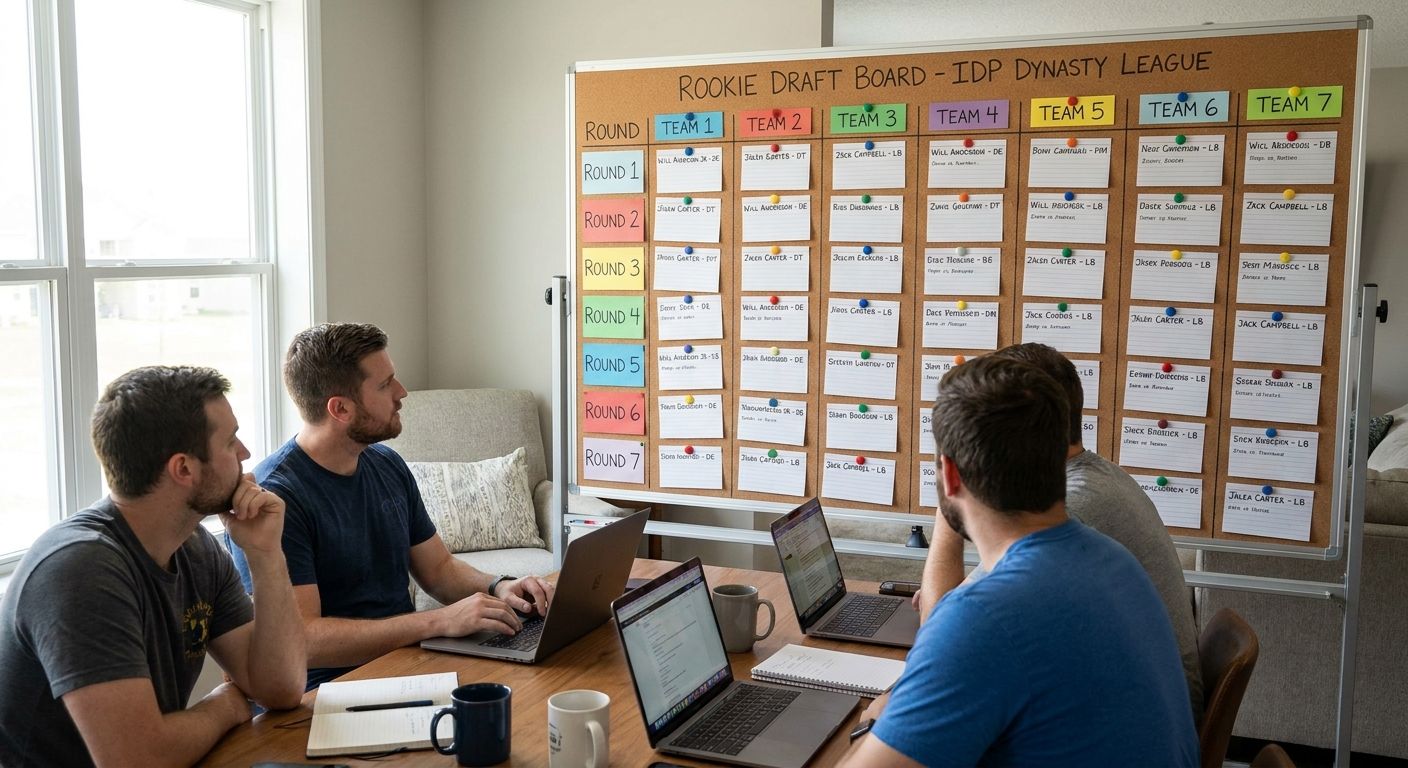
A fantasy sports lineup optimizer for Sleeper leagues ranks your roster by your league's actual scoring settings, not a generic PPR average, and tells you who to start each week. Sleeper managers running IDP, superflex, TE premium, or custom return-yard scoring need that distinction most, because a top-200 rankings list from ESPN or a print magazine has no idea those settings exist.
- A fantasy sports lineup optimizer for Sleeper leagues only works if it reads your league's real scoring settings, not a default.
- Generic rankings ignore IDP tackles, TE premium, and superflex bonuses — Sleeper managers in those formats lose the most value guessing.
- LeagueFrenzy connects to your Sleeper league and rebuilds start/sit ranks around your scoring, not a league-wide average.
- Waiver-wire values and lineup decisions are linked — check the wire before you lock Sunday's lineup, not after.
Why lineup optimization matters for Sleeper leagues
Sleeper is the platform managers pick specifically because it lets commissioners customize scoring past the defaults. Half-PPR, full-PPR, TE premium, IDP tackle-and-sack scoring, superflex, six-point passing touchdowns — all of it is a few taps away in league settings.
That flexibility is exactly why a fantasy sports lineup optimizer for Sleeper leagues built on generic rankings falls apart. A player who's a low-end flex in standard PPR can be a top-12 IDP linebacker in a league that pays 1.5 points per solo tackle. LeagueFrenzy pulls the league's actual scoring rules directly from Sleeper and reranks your roster against that, not against a league-average assumption written for a different format.
The practical effect shows up on Sundays. A generic rankings site tells you Player A is the better start in a vacuum. Your league's scoring might say the opposite once return yards, IDP snaps, or a superflex QB2 slot get factored in.
Pull your Sleeper league's actual scoring settings
Before anything else, know exactly what your league pays for. Most managers glance at this once at draft time in 2026 and never check it again during the season.
- Open your league settings on Sleeper and screenshot the full scoring page, not just the summary
- Note every non-standard rule: TE premium bonuses, tackle/sack/hurry values for IDP, return-yard scoring, bonus points for long touchdowns
- Check whether your league runs superflex, meaning a second quarterback slot competes with RB/WR/TE
- Confirm your PPR tier: 0, 0.5, or 1.0 point per reception changes flex value more than most managers realize
- Save the settings somewhere you'll reference weekly, not just at the draft
Rank your roster against your league's scoring, not generic ADP
Average draft position and consensus rankings are built for a hypothetical standard league. Your Sleeper league almost certainly isn't standard, so the rankings need a translation step.
- Cross-reference each of your starters against your league's actual point-per-stat values, not a generic tier list
- Flag any player whose value swings hard on a single custom rule, like an IDP linebacker in a tackle-heavy scoring system
- Rebuild your flex rankings separately for PPR tier — a 0.5-PPR flex order looks different from a full-PPR one
- In superflex leagues, re-rank quarterbacks as a flex-eligible position, not a standalone tier
- This is the point where a tool that reads your Sleeper scoring settings directly, like LeagueFrenzy's custom draft cheat sheets, saves the manual cross-referencing
Check the waiver wire before you set your lineup
A lineup optimizer that only looks at your current roster is doing half the job. The best start/sit decision this week might be a player who isn't on your roster yet.
- Scan Wednesday's waiver-wire results for snap-count jumps at your thin positions
- Compare available free agents against your worst starter using your league's scoring, not a generic add/drop grade
- Prioritize FAAB spend on players who help your specific scoring format, not whoever's trending league-wide
- Review Sleeper waiver wire values built from your league's rules before you submit a claim, not after
- Set a standing rule: no lineup lock until the waiver wire has been checked that week
Weigh matchup and injury risk against snap share
Rankings are a starting point, not a lineup. Two players with identical projected points carry different risk if one just returned from injury or lost snaps to a rookie.
- Check the latest snap-count report before locking any close start/sit call
- Downgrade any player on a practice-participation limit, even if the injury report says "probable"
- Weight matchup difficulty using your league's actual scoring — a run-funnel defense hurts an IDP linebacker's tackle total more than a standard RB
- Track target share trend over the last three games, not just last week's box score
- Never start a player purely on name recognition once the data disagrees
Build a start/sit shortlist and lock it early
Deciding Sunday morning under time pressure is how managers make their worst calls. A shortlist built Thursday, with waiver moves already in, removes the guesswork.
- List your top two options at every position with a genuine question mark
- Note the deciding factor for each — matchup, snap share, or a custom scoring quirk
- Lock backup plans for any player with a questionable injury tag
- Cross-check trade value if a roster gap keeps recurring; a trade analyzer for Sleeper leagues flags whether a deal fixes the hole better than another waiver claim would
- Set your lineup at least a few hours before kickoff, not five minutes before lock
Re-check IDP and superflex slots separately
Standard start/sit logic breaks down fastest in IDP and superflex formats, because those roster slots don't map to any generic ranking system.
- Rank IDP starters by your league's exact per-stat values — tackle-heavy scoring favors linebackers, sack-heavy scoring favors edge rushers
- Treat your superflex QB2 slot as a true flex decision against your best RB/WR, not an automatic start
- Watch for game-script shifts that change IDP snap counts, like a blowout limiting a run-stopping linebacker's tackle chances
- Don't apply a standard-league DL/LB/DB tier list to a league with custom position multipliers
Track your weekly accuracy
A lineup process only proves itself over a full season. Track whether your start/sit calls beat your bench points, and adjust the process, not just the roster.
- Log actual points scored versus your bench's best alternative every week
- Note which decisions were close calls that could have gone either way
- Flag any recurring mistake, like consistently underrating IDP scoring or overrating name-brand receivers
- Revisit your process every four weeks, not just at the trade deadline
Comparing lineup optimizer options for Sleeper leagues
| Option | Best for | Key limitation |
|---|---|---|
| Sleeper's built-in projections | Quick, in-app glance at default rankings | Uses generic scoring assumptions, not your league's custom rules |
| Generic top-200 rankings sites | Standard 0.5-PPR, non-superflex, non-IDP leagues | Blind to TE premium, IDP tackle scoring, and superflex value shifts |
| Manual spreadsheet tracking | Managers who want full control and have the time | Time-intensive every week; easy to miss snap-count and waiver changes |
| LeagueFrenzy custom lineup tool | Sleeper managers with custom scoring, IDP, or superflex | Less differentiated in plain standard-PPR, non-custom leagues |
Verdict: if your Sleeper league runs any custom scoring — IDP, superflex, TE premium, or non-standard PPR — a generic optimizer is guessing at your rules. A tool built around your league's actual settings, like LeagueFrenzy, isn't optional at that point, it's the only version of the data that's actually accurate.
Connect your Sleeper league
Get lineup ranks built from your league's actual scoring rules.
Common mistakes Sleeper managers make with lineup decisions
- Trusting Sleeper's default projections in a custom-scoring league. The app's built-in numbers assume a standard rule set that your league settings already overrode.
- Setting lineups off ESPN or Yahoo consensus rankings. Those rankings are built for their own platform's default scoring, not your league's tackle bonuses or superflex slot.
- Ignoring the waiver wire until after the lineup is locked. The best start this week is sometimes a player who isn't rostered yet.
- Overreacting to one bad week without checking snap share. A single down game means little if target share and snaps haven't actually dropped.
- Applying standard IDP tiers to a custom tackle-heavy or sack-heavy league. Position value in IDP formats shifts hard based on exactly how your league weights each stat category.
FAQ
What is a fantasy sports lineup optimizer for Sleeper leagues?
It's a tool that ranks your Sleeper roster by your league's actual scoring settings — PPR tier, IDP values, superflex, TE premium — instead of a generic league-average projection. The output is a weekly start/sit recommendation specific to your rules.
Does Sleeper have a built-in lineup optimizer?
Sleeper shows in-app projections and a default lineup suggestion, but those numbers use broad scoring assumptions rather than every custom rule a commissioner sets. Leagues with IDP, superflex, or non-standard PPR need a tool built specifically around their scoring.
Is a custom lineup optimizer better than generic rankings for Sleeper leagues?
Yes, in any league with custom scoring, because generic rankings are built for a hypothetical standard format. In a plain, standard-PPR Sleeper league without IDP or superflex, the gap between generic and custom rankings narrows considerably.
How does LeagueFrenzy build lineups for Sleeper leagues?
LeagueFrenzy connects directly to a manager's Sleeper league and reads the actual scoring rules on file, then reranks the roster, waiver wire, and trade values against those specific settings rather than a default template.
Can a lineup optimizer work for IDP or superflex Sleeper leagues?
Yes, but it has to read the league's individual defensive scoring and second-QB slot rules to do it correctly. A tool built only for standard offense-only formats will misprice both IDP starters and superflex quarterbacks.
How often should I check my Sleeper lineup before kickoff?
Build a shortlist by Thursday using the week's injury reports and waiver moves, then confirm it a few hours before Sunday kickoff after final inactives are posted. Locking a lineup minutes before kickoff leaves no room to react to late scratches.
Do I need a paid tool to optimize my Sleeper lineup?
Not strictly — a manager willing to cross-reference scoring settings, snap counts, and waiver values manually every week can do it for free. A paid tool mainly saves the weekly time cost of that cross-referencing, which compounds over a 17-week season.
Does a lineup optimizer account for waiver-wire pickups?
A complete one does — the best lineup decision each week sometimes involves a player who isn't rostered yet. Waiver values and lineup ranks need to be built from the same scoring settings to stay consistent.
One last thing
The managers who lose the most value in custom Sleeper leagues aren't the ones who ignore rankings entirely — they're the ones who trust a generic top-200 list and assume it already accounts for their league's IDP tackle bonuses or superflex slot. It doesn't. Check the scoring settings page once more before the next lineup lock; most managers haven't looked at it since draft day.