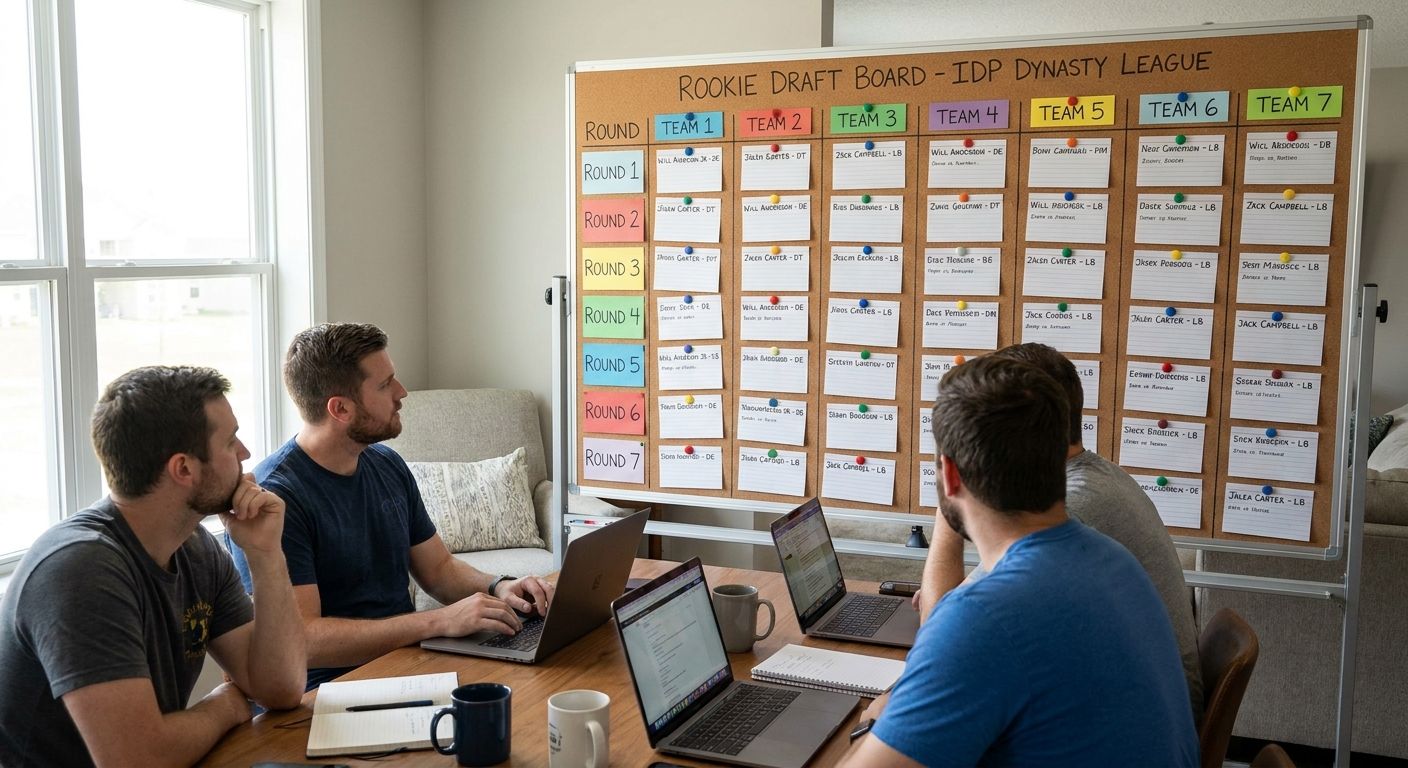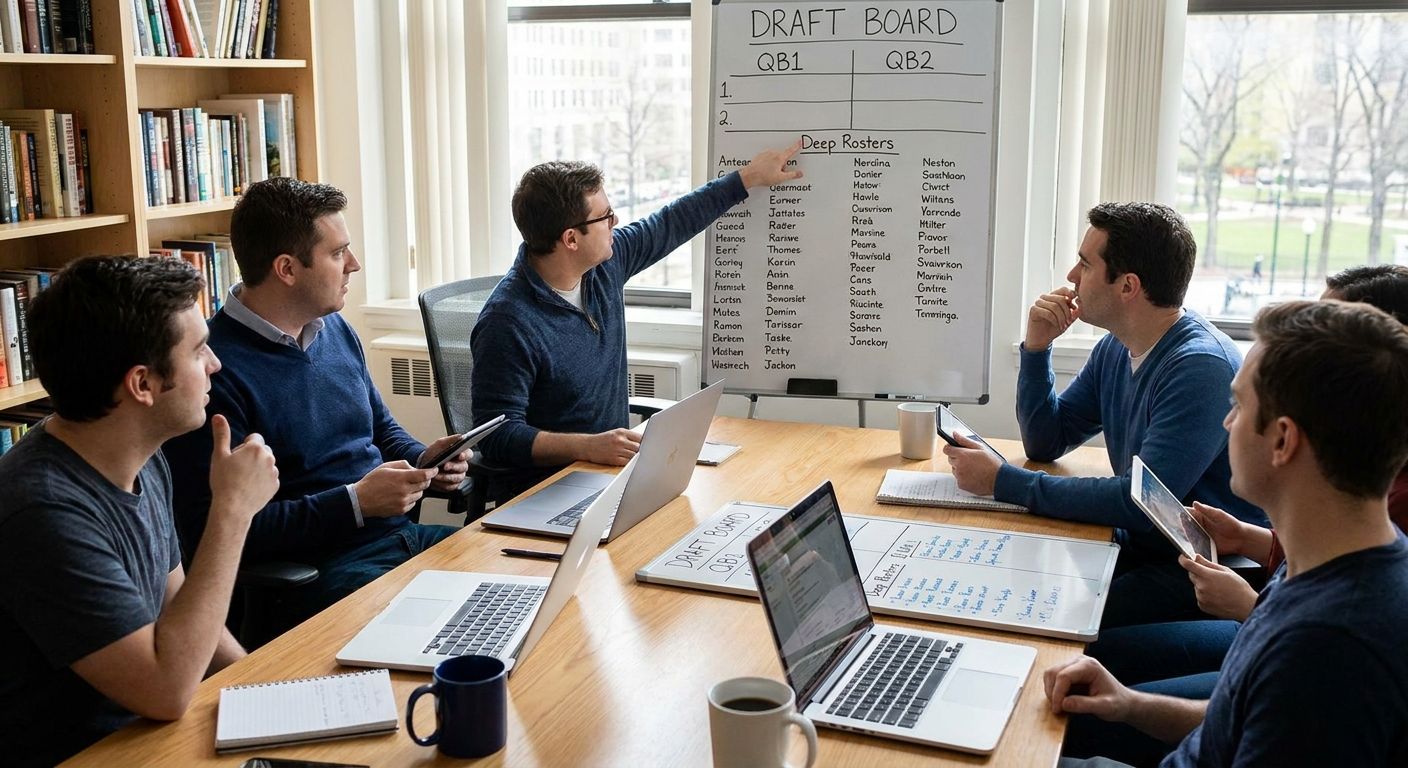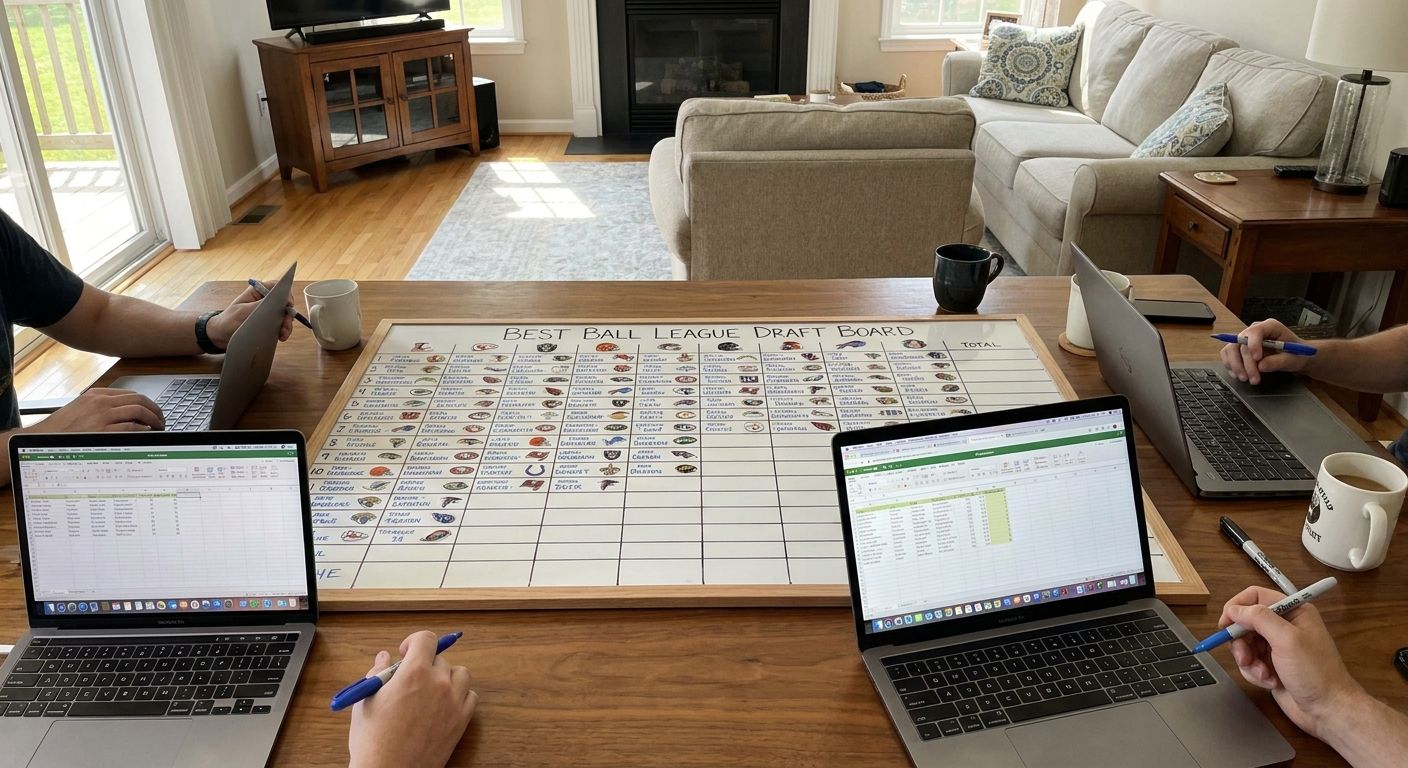
A fantasy football draft board for best ball leagues has to rank players by weekly ceiling and target-share stability, not season-long floor, because the format auto-starts your highest scorers every week and never lets you bench a bust. Best ball managers get one input — the draft — and everything else runs on autopilot, so the board you draft from carries more weight than in any other format.
- A fantasy football draft board for best ball leagues ranks players on weekly ceiling and target share, not season-long floor projections.
- Standard PPR cheat sheets ignore bye-week stacking and roster-slot limits, which matter more in best ball than in redraft.
- LeagueFrenzy builds a custom draft board from your connected Sleeper, MFL, Fleaflicker or ESPN league so positional tiers match your real roster construction.
- Zero-RB and Hero-RB builds lean on bench depth since best ball offers no waiver wire to patch an early bust.
- Auction best ball drafts need a separate nomination strategy — scarcity plays out differently than in a snake draft.
Why fantasy football draft boards matter for best ball leagues
Once a best ball draft closes on LeagueFrenzy-connected platforms like Sleeper, MFL, Fleaflicker or ESPN, you stop making roster decisions. There's no waiver wire to add a breakout, no lineup to set on Sunday morning, and in most formats no trade deadline to fix a mistake. The algorithm slots your top scorers at each position automatically, every single week of the 2026 season.
That changes what a draft board should optimize for. A redraft board built for a league with waivers and lineup decisions rewards floor and consistency, because a bad week can be benched. A fantasy football draft board for best ball leagues has to reward ceiling and bye-week coverage instead, since every rostered player's score counts toward your total the moment they're eligible and your bench is your only insurance policy.
Generic consensus rankings don't know your roster size, your bye-week distribution, or whether your league runs TE premium or superflex scoring. A board built off your league's actual settings does.
Rank players by weekly ceiling, not season floor
Season-long point totals hide the players who actually help you win best ball weeks. A running back who scores 14 points every week has a higher floor than one who scores 4 or 28, but only the second one wins you a week outright.
- Sort by points-per-game variance, not just average points per game
- Weight target share and red-zone touch rate above raw yardage totals
- Treat injury-prone, high-ceiling players as bench-depth bets rather than automatic fades
- Flag players in contract years or new offensive schemes for ceiling volatility
- Cross-check any player's best-ball-specific ADP against redraft ADP for gaps
Build your roster construction plan before round one
Best ball rewards a plan going into the draft more than a round-by-round reaction to value. Zero-RB, Hero-RB and Robust-RB are the three dominant approaches, and each changes how your bench absorbs a bye week or an injury.
- Zero-RB: hammer wide receiver and tight end early, load running back depth in the middle rounds where injury upside is cheap
- Hero-RB: take one true bell-cow back in the first two rounds, then pivot to receivers before circling back to running back volume
- Robust-RB: prioritize three or four running backs in the first six rounds to lock in weekly floor at the position with the most weekly attrition
- Pick one philosophy and stick to it through the middle rounds — best ball drafts punish managers who reverse strategy mid-draft
- Reserve your final three to four rounds for pure ceiling shots regardless of position
Load your league's actual scoring settings into the board
A generic cheat sheet treats every league the same. Your league doesn't score the same as the one the rankings were built for — TE premium, six-point passing touchdowns, and IDP tackle bonuses all move players up or down tiers by rounds, not spots.
Connecting your league lets a best ball lineup optimizer and draft board reflect those settings instead of assuming standard scoring. That matters most in the middle rounds, where a tight end who's mediocre in standard PPR can be a top-24 asset in a TE premium format.
- Confirm your league's PPR value (0.5, full, or none) before ranking flex-eligible players
- Check for TE premium or bonus scoring that reshapes the tight end tier
- Note IDP or superflex rules that pull entire position groups up the board
- Verify your roster slots — deeper benches change how aggressively you can chase ceiling early
- Re-rank your top 100 once scoring settings are applied, not before
Stack bye weeks against your bench depth
Best ball has no waiver wire to replace a zero-point bye week, so a cluster of your best players sharing a bye can cost you a week outright. This is the single most best-ball-specific adjustment a manager makes, and it's the one generic boards skip entirely.
- Map every drafted player's bye week as you go, not after the draft ends
- Avoid rostering your top three players at any position on the same bye
- Prioritize roster balance across bye weeks over squeezing in one more high-ADP name
- Treat late-round dart throws as bye-week insurance, not just upside plays
- Recheck your full 18-round roster for bye clustering before the draft closes
Adjust for auction versus snake best ball formats
Snake draft value doesn't translate directly to auction nomination strategy. In an auction, scarcity at a position shows up in bidding wars, not draft slot, and a fantasy football draft board for auction draft leagues needs price tiers instead of pick-number tiers.
- Build separate tiers for auction that reflect bidding scarcity, not snake ADP
- Nominate players outside your target range early to drain other managers' budgets
- Hold back on your Zero-RB or Hero-RB targets until mid-auction when prices soften
- Track remaining budget per manager, not just your own, as the auction progresses
Comparison: draft board options for best ball leagues
| Option | Best for | Key limitation |
|---|---|---|
| Generic consensus rankings | Fast start with zero setup | Ignores your league's scoring and bye-week structure entirely |
| ADP-based cheat sheets | Draft-day speed reference | Lags injury and holdout news by days or weeks |
| Custom draft board from your connected league | Managers running TE premium, superflex or IDP scoring | Still needs your own Zero-RB/Hero-RB philosophy layered on top |
| Manual spreadsheet or tiering | Managers who want full control of the model | Time-intensive and stale the moment news breaks |
| Sleeper-native draft tools | Managers drafting best ball inside Sleeper | Built around Sleeper's default settings, not custom scoring quirks |
For managers drafting inside Sleeper specifically, custom draft cheat sheets for Sleeper leagues apply your league's real settings on top of Sleeper's interface rather than replacing it.
Connect your best ball league
Build a draft board from your league's actual scoring and roster rules.
Common mistakes best ball managers make
- Drafting for season-long floor. A low-ceiling, high-floor player caps your best weeks in a format that only counts your best weeks.
- Ignoring bye-week stacking. With no waiver wire to patch a zero, three key players sharing a bye is a self-inflicted loss.
- Using standard redraft ADP instead of best-ball-specific ADP. Best ball ADP skews differently because managers draft for ceiling, not floor, from round one.
- Underweighting scoring bonuses. TE premium and superflex leagues move entire tiers, and a generic board never reflects it.
- Reversing strategy mid-draft. Switching from Zero-RB to Robust-RB in round 8 usually leaves you thin at both running back and receiver.
Verdict: a fantasy football draft board for best ball leagues built off your league's real scoring settings beats a generic cheat sheet every time bye-week structure or bonus scoring is in play.
FAQ
What's the best fantasy football draft board for best ball leagues?
The best draft board for best ball is one built from your league's actual scoring settings and bye-week schedule, not a generic consensus ranking. A board that reflects TE premium, superflex or PPR value moves entire tiers by rounds, not spots.
Is a custom draft board better than generic best ball rankings?
Yes, for any league running non-standard scoring like TE premium, IDP or superflex, because generic rankings assume default settings that don't apply. For plain standard-PPR best ball, the gap between custom and generic boards is smaller.
How is a best ball draft board different from a redraft board?
A best ball board prioritizes weekly ceiling and bye-week coverage since there's no waiver wire or lineup-setting to correct a mistake after the draft. A redraft board can lean more on floor and consistency because managers can still bench or replace players in-season.
Does best ball ADP differ from standard fantasy ADP?
Yes, best ball ADP skews toward ceiling players earlier because managers draft knowing they can't bench a bust or start a waiver pickup. Injury-prone, high-upside players often go several rounds earlier in best ball ADP than in standard redraft ADP.
How much does a fantasy football draft board cost?
Costs range from free consensus rankings to paid subscription tools that customize the board to your league's scoring and roster rules. Check current pricing directly on the tool's site since it varies by provider and plan.
Can I use the same draft board for auction and snake best ball drafts?
No, not without adjustment. Auction drafts need price tiers built around bidding scarcity, while snake drafts need pick-number tiers, so the same player list ranks differently depending on format.
Do I need to update my draft board during the season in best ball?
No, since most best ball formats lock the roster at the draft and don't allow waiver claims or lineup changes. Your board only matters on draft day, which is why pre-draft accuracy carries more weight than in redraft leagues.
Is Zero-RB a good strategy for best ball leagues?
Zero-RB works well in best ball because the format's deep benches let you stockpile running back depth in the middle rounds while locking in receiver and tight end ceiling early. It's not the only viable build, but it fits best ball's no-waiver structure better than in standard redraft.
One last thing
The biggest edge available in best ball redraft isn't a sleeper pick — it's stacking a quarterback with two of his pass-catchers from offenses that don't share a bye week. That construction doubles your ceiling weeks from one offense's explosive games without doubling your bye-week exposure, and it's the kind of roster-construction detail a generic top-200 list never accounts for.