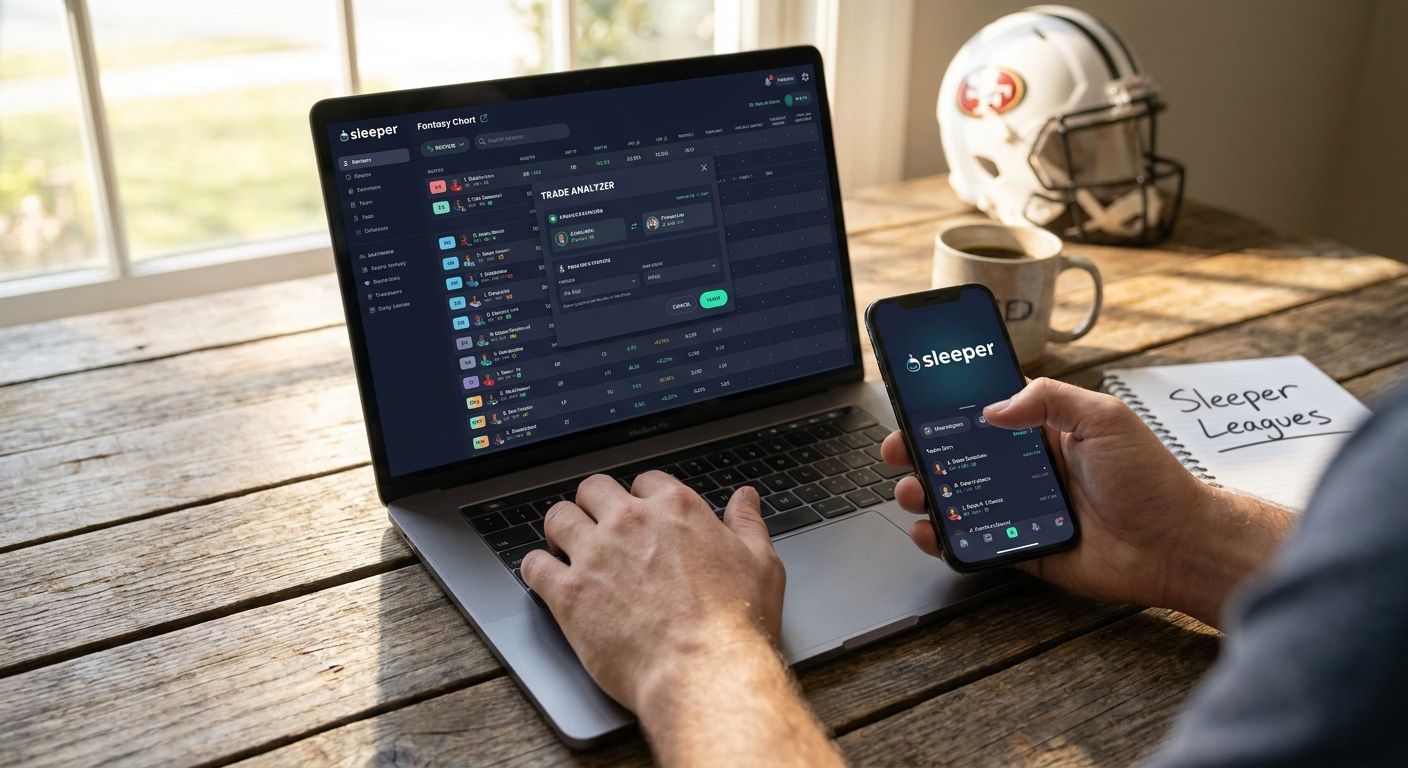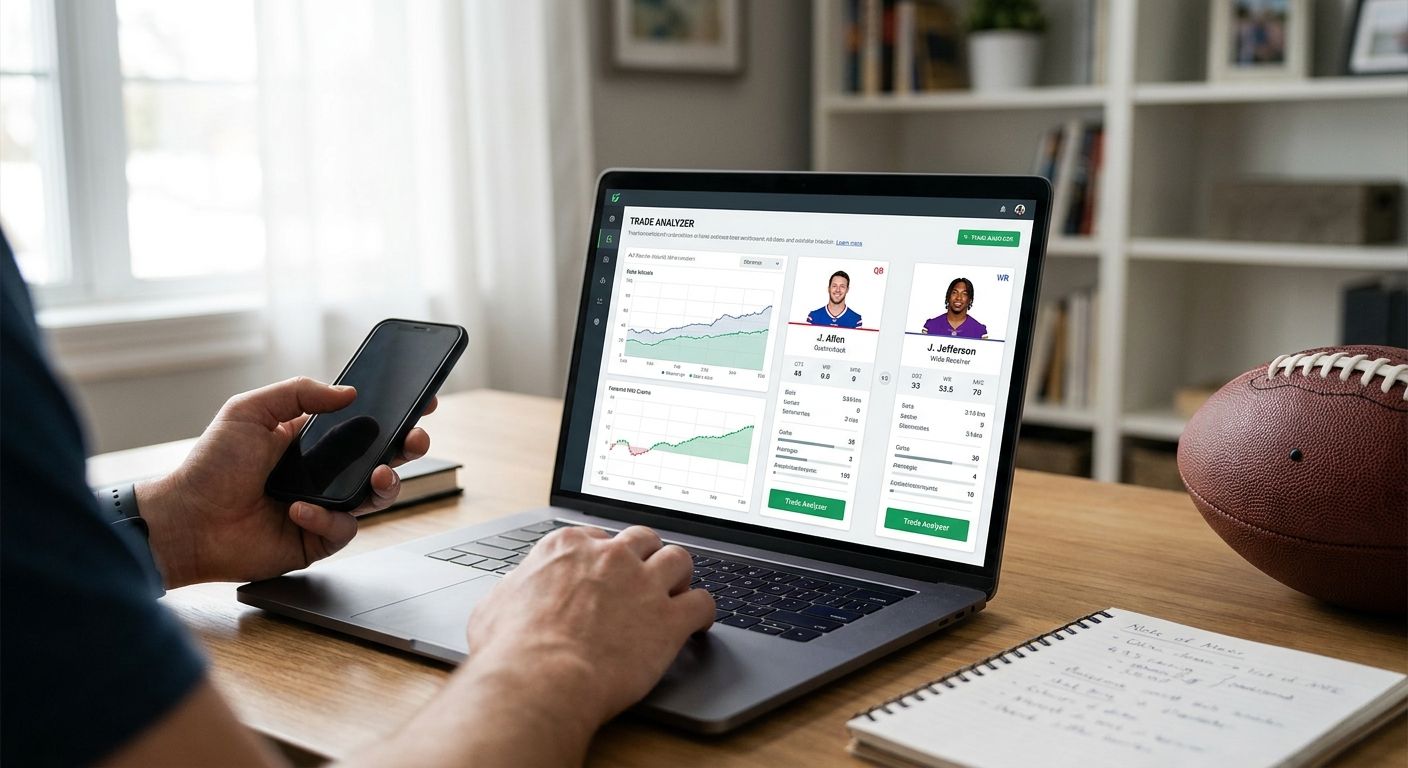
You want a trade grade that knows your league runs 1.0 PPR with a TE premium and two flex spots, not a generic chart built for a 10-team half-PPR default. This guide breaks down the fantasy football trade analyzer for ESPN leagues options worth your time in 2026, and where each one quietly gets your specific rules wrong.
- ESPN's built-in trade analyzer scores trades on generic positional rank, not your league's scoring settings: Skip it for anything beyond a gut check.
- FantasyPros Trade Analyzer works across platforms including ESPN but still runs on crowd-sourced rankings, not your roster: Consider it as a second opinion.
- Value-chart methods (KeepTradeCut-style) answer a redraft or dynasty market price question, not a rules question: Consider for dynasty, Skip for IDP or superflex.
- LeagueFrenzy connects directly to your ESPN league and grades trades against your actual scoring rules, including IDP and superflex: Buy for 2026.
Why this matters
A trade analyzer that doesn't read your league's scoring settings is answering a different question than the one you asked. If your ESPN league runs IDP with tackle-and-a-half scoring, or a superflex format where a QB2 outproduces a WR1, a generic rank-based grade will tell you a trade is lopsided when it's actually even, or vice versa. LeagueFrenzy exists specifically to close that gap: it connects to your ESPN league and builds trade verdicts from your league's real scoring rules, not a league-average approximation.
The distinction matters most in three spots: IDP leagues, superflex/2-QB leagues, and leagues with custom bonus scoring (return yards, TE premium, first downs). Standard trade tools treat all of those leagues like a default 12-team, 0.5 PPR format. In 2026, with rosters getting deeper and waiver churn faster, that gap in accuracy compounds every week you leave it unaddressed.
Who this is for
This guide is for the ESPN league manager who has already been burned once — the guy who accepted a trade the generic analyzer called "fair" and then watched his IDP linebacker score half his projected points because the tool never saw his league's tackle-and-a-half rule. If your league is standard 0.5 PPR with no IDP and no superflex, a generic tool will get you closer than you'd think. If your league has any custom wrinkle, that's where this comparison earns its keep.
What to look for in a trade analyzer for ESPN leagues
Scoring-rule ingestion, not scoring-rule guessing
A tool that asks you to manually re-enter your scoring settings, or worse, assumes a default, is going to drift from your actual league math the moment you have a non-standard rule. The right tool pulls your league's scoring settings directly from the platform.
IDP and superflex awareness
If your league starts a flex QB or requires a full defensive lineup, positional value shifts hard. A tool built for standard offense-only formats simply has no framework for grading an IDP-for-WR trade.
Roster context, not just player value
The same trade can be a steal for a team missing a bye-week fill-in and a mistake for a team already deep at that position. A trade grade that only compares player-to-player value misses your actual roster need.
An explicit verdict, not a number
A point differential of "+4.2" tells you nothing actionable. You need a tool that tells you to accept, decline, or counter, and why.
Update cadence through the season
Values that don't move after Week 1 injuries or a breakout Week 4 performance are stale by midseason. Look for a tool that recalculates weekly, not once in August.
Direct platform connection
Manually re-entering your 12-team ESPN league's roster and scoring every week is where most managers give up on trade tools by Week 6. A direct login or API connection removes that friction entirely.
Top picks for grading ESPN trades
ESPN's native Trade Analyzer — the default pick. It's built into the platform you're already using, and it grades on ESPN's own player rankings and rest-of-season projections. It does not read your league's custom scoring rules — a standard 0.5 PPR default underlies every grade, regardless of whether your league runs full PPR or IDP. For a vanilla 12-team league with no custom scoring, it's a fine gut check. For anything with IDP, superflex, or bonus scoring, the grade is answering the wrong question. Verdict: Skip for custom-scoring leagues, Consider for standard formats.
FantasyPros Trade Analyzer — the crowd-sourced pick. It aggregates expert rankings and works across platforms, ESPN included, so you're not locked out if your league lives there. The tradeoff is the same one every consensus tool has: it grades against average expert rankings, not your league's actual point-scoring math. In a 1.0 PPR TE-premium league, that gap shows up fast. Verdict: Consider as a second opinion, not a primary source.
Dynasty value charts (KeepTradeCut-style) — the market-price pick. These reflect community trade activity and market sentiment, which is useful for dynasty startup value and long-term asset trading. They answer "what would the market pay," not "is this a fair trade for my league's scoring rules and my roster's actual need this week." In IDP or superflex formats, the underlying market skews toward the leagues that dominate trade volume — usually redraft and startup dynasty — and undervalues your specific format. Verdict: Consider for dynasty asset tracking, Skip as your weekly in-season trade grader.
LeagueFrenzy — the league-aware pick. It connects directly to your ESPN league, pulls your actual scoring settings, and builds trade verdicts from those rules instead of a league-average approximation. That means IDP tackle rules, superflex QB scarcity, and TE premium bonuses all factor into the grade the same way they factor into your actual standings. Verdict: Buy if your ESPN league has any custom scoring wrinkle.
What to avoid
- A "fair trade" verdict with no context. A tool that outputs a single number and no reasoning gives you nothing to act on when your league mate pushes back.
- Redraft value charts applied to a dynasty or superflex league. The replacement-level math is different in each format — a chart built for one will misprice the other.
- Manually copying your scoring settings into a generic calculator. One missed setting (a bonus for 100+ rushing yards, a half-point IDP tackle) throws off every grade that follows.
Verdict comparison
| Tool | Reads your ESPN scoring rules | Handles IDP/superflex | Explicit verdict | 2026 verdict |
|---|---|---|---|---|
| ESPN native Trade Analyzer | No | No | No | Skip (custom scoring) |
| FantasyPros Trade Analyzer | No | Partial | No | Consider |
| Dynasty value charts | No | No | No | Consider (dynasty only) |
| LeagueFrenzy | Yes | Yes | Yes | Buy |
Grade your next ESPN trade
Connect your ESPN league and get a verdict built from your actual scoring rules.
FAQ
What is the best fantasy football trade analyzer for ESPN leagues in 2026?
For leagues with IDP, superflex, or custom scoring, a tool that connects directly to your ESPN league and reads its actual scoring rules grades trades more accurately than a generic consensus tool. For standard 0.5 PPR leagues with no custom rules, ESPN's built-in analyzer is a reasonable gut check.
Is ESPN's built-in trade analyzer accurate?
It's accurate for standard scoring formats close to ESPN's own default settings. It does not read your league's custom scoring rules, so IDP, superflex, and bonus-scoring leagues will get a grade that doesn't reflect their actual point math.
Does a trade analyzer need to know my league's scoring settings?
Yes, if your league has any non-standard rule. A player's trade value shifts significantly between a standard PPR league and an IDP or superflex league, and a tool ignoring that difference is grading a different league than yours.
Can I use FantasyPros Trade Analyzer for an ESPN league?
Yes, FantasyPros Trade Analyzer works across platforms including ESPN. It grades against consensus expert rankings rather than your league's specific scoring rules, so treat it as a second opinion rather than a final answer.
Are dynasty value charts useful for in-season ESPN trades?
They're built for tracking long-term asset value and market sentiment, mostly in dynasty and superflex startup contexts. For a weekly in-season trade decision tied to your specific roster need, they're the wrong tool.
How often should trade values update during the season?
Weekly, at minimum, after injuries, byes, and performance shifts change a player's actual scoring output. A tool that only updates once before the season starts is grading trades against outdated projections by midseason.
Does IDP scoring change trade value significantly?
Yes. A linebacker in a tackle-and-a-half league scores meaningfully differently than the same player in a league without IDP at all, and a generic trade tool built for offense-only formats has no framework to grade that difference.
Is a superflex QB worth more in trades than in a standard league?
Yes, significantly. Starting two QBs changes replacement-level value at the position, and a trade analyzer that doesn't account for superflex will consistently undervalue QB2 assets in those leagues.
One last thing
The gap between a generic trade grade and a league-aware one is widest in the format most managers assume is covered: superflex. Moving from single-QB to superflex doesn't just add a roster spot, it reorders scarcity across the entire position, and a tool grading off single-QB assumptions will keep telling you a QB2-for-WR2 trade favors the wrong side all season. Check any trade grade against your league's actual starting requirements before you accept it in 2026.